
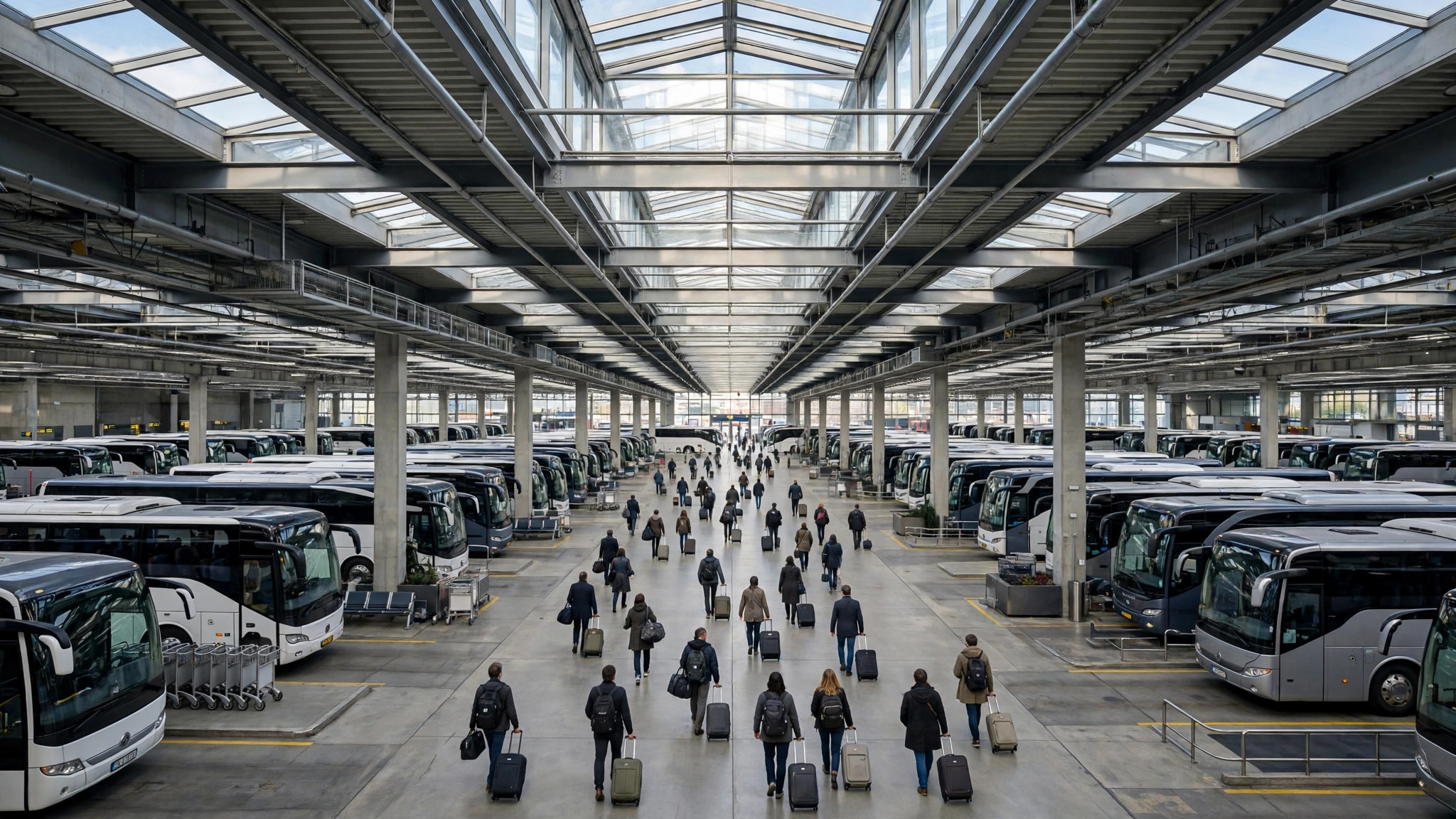
A bus station crowd is a departure crowd: it does not drift in and out like shoppers, it assembles for specific buses and dissolves when they leave. That makes bus station busiest times a timetable question as much as a clock question — the terminal fills in banks before big departures, empties between them, and swells beyond recognition on the Friday evenings and holiday eves when a whole city tries to leave at once. Most intercity terminals carry Google Maps listings with popular times graphs, and once you know how to read them against the departure board, you can pick the sailing — or rather, the bus — that travels calm.
This guide covers the daily departure banks, the weekly and holiday surges, how Google Maps’ transit crowdedness predictions help with the buses themselves, and the special case of India’s great intercity terminals. It sits alongside our guides to railway station busiest hours and metro station rush hour times — the same departure logic at different scales.
The departure banks: how a terminal fills
A terminal’s day is a sequence of banks. The early-morning bank is the largest at many intercity stations: long-distance buses leave from about 5 am to 9 am so they can arrive by evening, and their passengers arrive through the pre-dawn hours — commuters’ opposite number, travellers who set alarms for 3:30 am. A smaller midday bank serves afternoon departures. The evening bank, roughly 6 pm to 10 pm, loads the overnight buses and is, at many terminals, the day’s biggest.
Between banks, even a famous terminal can feel half-asleep. The popular times graph shows this as a distinctive multi-humped curve, and the practical lesson follows directly: your crowd is your bank. A 10:30 am departure travels in the valley between banks, with short ticket queues, empty seats in the waiting hall and a bus that is likelier to leave on time. The same route at 7:30 pm puts you in the middle of the evening bank’s full weight.
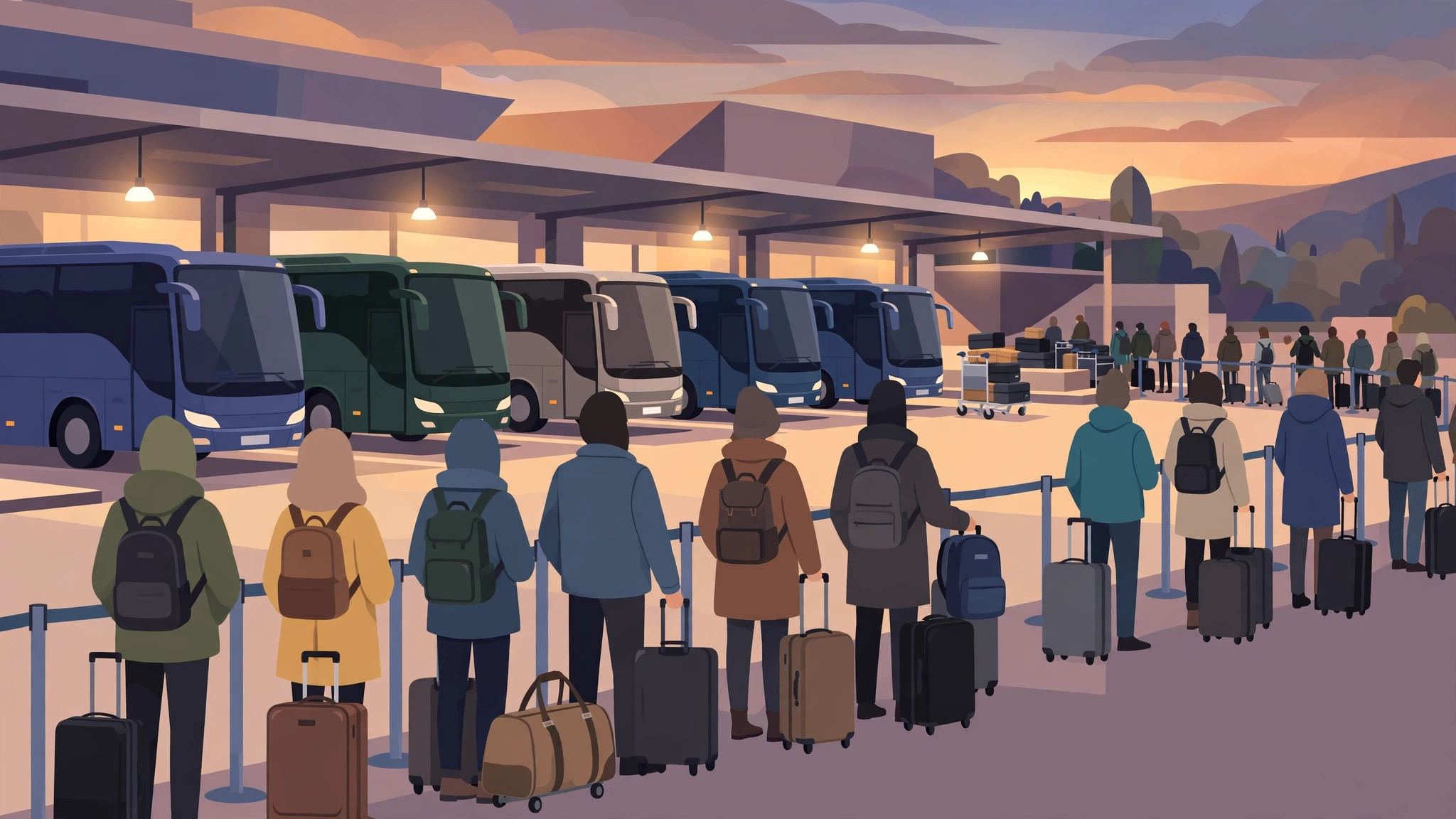
google map will show how crowded busses wil be
For the buses themselves — as opposed to the terminal building — Google Maps offers something no departure board does: crowdedness predictions on transit routes. On supported routes, Maps shows how crowded a bus is likely to be, built from reports by riders who travelled the same service and shared anonymously whether they found a seat or stood. Where the feature is live, the prediction appears in the transit directions for the specific departure you are planning to take.
Used well, this changes which bus you choose. Two departures twenty minutes apart on the same corridor can carry completely different loads — the first after a gap is packed, the second runs half-empty — and the prediction makes that visible in advance. It is most valuable on city and commuter routes, where you have a real choice of departures. For intercity services with booked seats, the prediction matters less than the terminal crowd itself; for unreserved routes, it is the difference between a seat and two hours standing in the aisle. Google documents the feature in its Google Maps Help pages on transit directions, including where predictions are available.
Friday evenings, holiday eves and the festival exodus
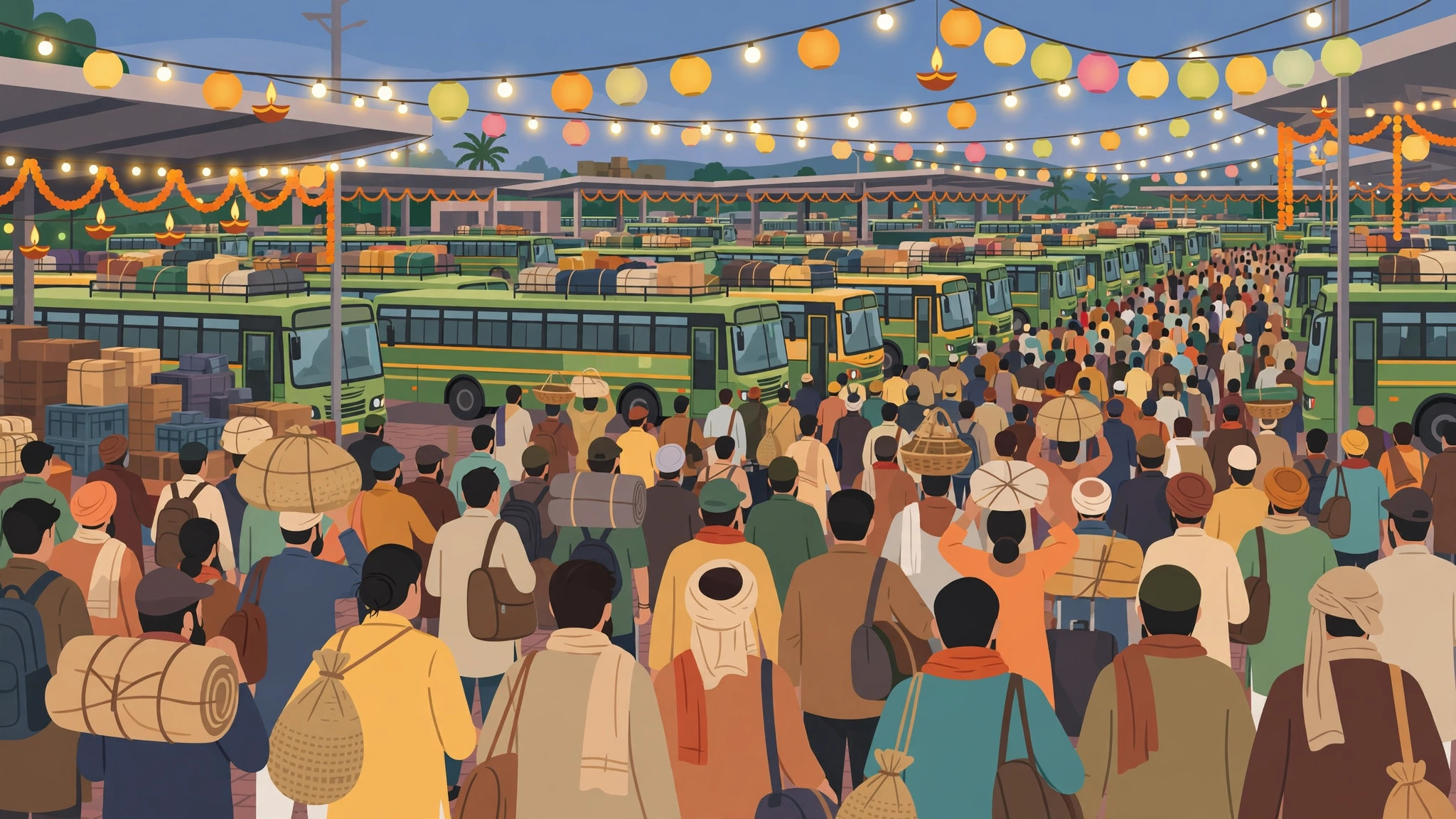
Every terminal’s biggest day is a leaving day. Friday evening stacks the whole week’s demand into a few hours: workers heading to home towns, students, families starting weekend trips. The evening bank doubles in size and starts earlier, ticket queues reach their weekly maximum, and unreserved buses fill before they reach the bay. The day before a major holiday is Friday evening squared — in India, the eve of Diwali and the start of Chhath or Eid travel produce terminal crowds that are a news story every year.
The mirror image is the return surge: Sunday evening and the last day of a holiday period, when the same crowd flows back. Terminals handle departures better than arrivals — arriving passengers disperse — but the taxi queues, auto stands and local bus connections outside absorb the crush instead. Planning around the exodus is mostly about not joining it: travel Thursday evening or Saturday morning instead of Friday, and return Saturday or Monday rather than Sunday night, and the same journey happens in a different, calmer world.
City bus terminals vs intercity terminals
The two terminal types run different clocks. A city bus terminus serves departures every few minutes, so its crowd is a flow, peaking with the commute — morning and evening rushes where the queue is for a stream of buses rather than a single one. Its graph looks like a metro station’s: twin humps, quiet middle.
An intercity terminal serves banks, as described above, and adds the long-distance traveller’s apparatus: luggage, advance-booking counters, enquiry windows and the families seeing passengers off, who swell the crowd beyond the passenger count. Its peaks are spikier, its valleys deeper, and its special days bigger. Reading the graph, the first question is always which type of terminal you are looking at — the same bar height means flow at one and a departure bank at the other.
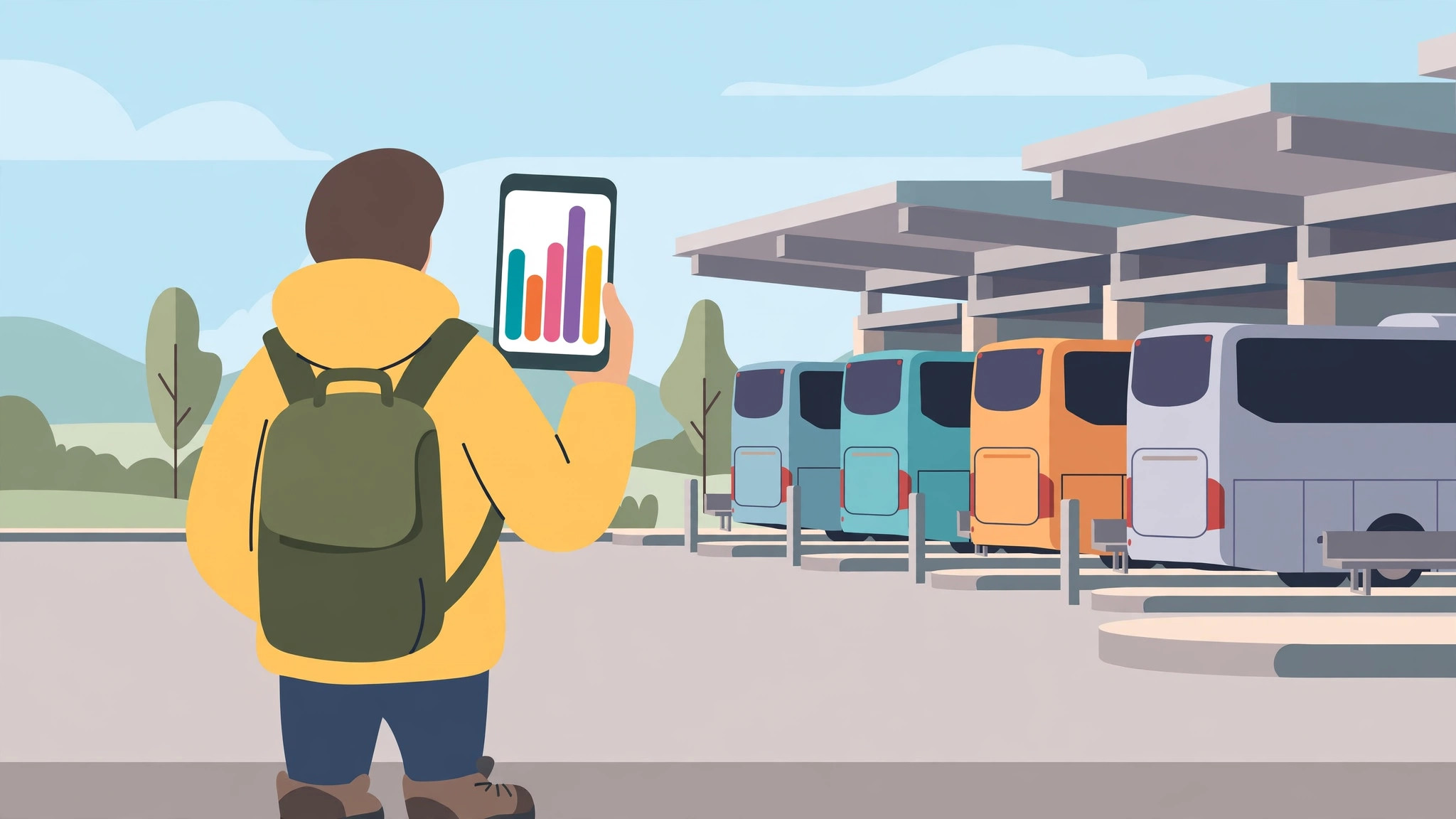
Bus station busiest times: checking the terminal before you go
The routine for this series, tuned for terminals:
- Open the terminal’s listing and read the graph against the departure board, not the clock — find your bank, then read its height.
- Check the same departure on other days; intercity banks differ enormously between a Tuesday and a Friday.
- Use the live bar on travel day itself, especially on eves and Fridays, when real crowds outrun the historical curve.
- For the bus itself, check the transit crowdedness prediction in directions where available, and prefer the departure after the obvious one.
Traffic to the terminal deserves its own check: terminal districts jam precisely when the banks form, so the live traffic view on approach roads is part of the timing decision, not an afterthought.
India: ISBTs, state transport and the festival special
India’s inter-state bus terminals — Delhi’s ISBTs at Kashmere Gate, Anand Vihar and Sarai Kale Khan, and their counterparts in every state capital — are among the largest bus stations in the world, and their peaks are correspondingly grand. The morning and evening banks merge with the city’s commuter flows; state transport undertakings run festival special services that add departures but also add crowd; and private operators’ boarding points scattered around the terminal district create satellite crowds the main listing does not capture.
The festival exodus from big-city ISBTs — Diwali and Chhath departures toward Uttar Pradesh and Bihar are the famous case — produces queues that begin the previous day. The counter-strategy is the same as everywhere, executed earlier: book reserved services rather than relying on walk-up departures, travel a day before the eve rather than on it, and treat the terminal’s graph in festival week as a floor, not a forecast.
Night buses and the sleeper crowd
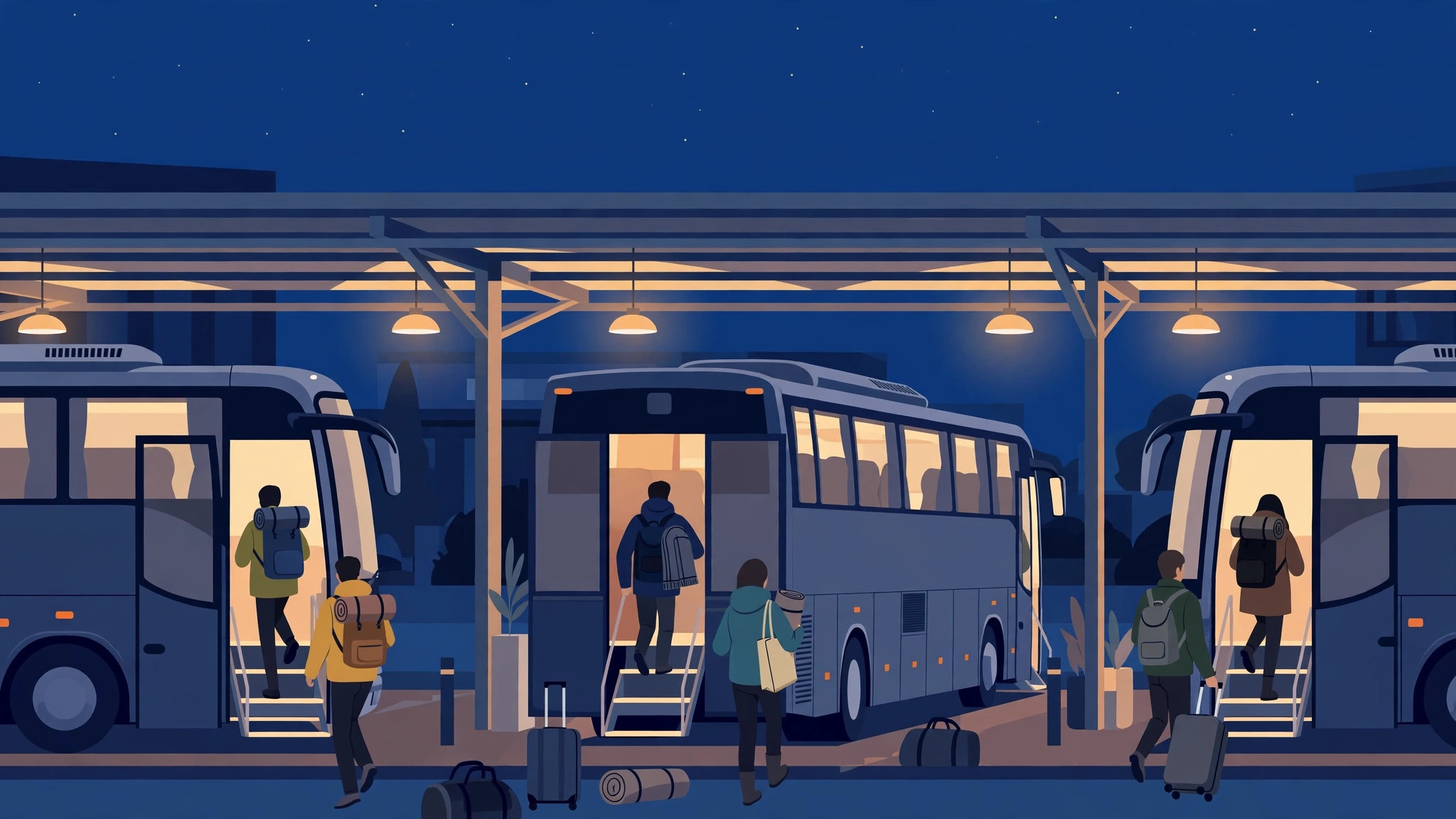
The evening bank exists because of the sleeper bus. Overnight services are scheduled to arrive at breakfast time, so they leave in a tight window after dinner — and their passengers, travelling with luggage for a full night’s journey, arrive earlier and wait longer than day passengers. Terminals with heavy sleeper traffic therefore run their deepest crowd of the day between about 8 pm and 11 pm, when waiting halls fill with families, bedding rolls and snack vendors doing their best business of the day.
For daytime travellers the lesson is to not mistake the night crowd for theirs: an 8 pm graph peak built by sleeper passengers says little about the queue for a 4 pm departure. For sleeper passengers themselves, the move is the reverse — arrive early enough to board calmly, because a sleeper bus that fills its bay late compresses the whole crowd’s boarding into the final minutes.
Weather, breakdowns and the crowd that stays
Terminals also have a crowd nobody scheduled: the stranded one. A cancelled departure, a highway closure or a storm does not disperse a bank — it parks it in the waiting hall, where it merges with the next bank and the one after that. On disruption days the graph is useless and the live bar only tells you what you can see from the door. The real signals are the departure board’s delay column and the enquiry window’s queue.
The traveller’s defence is slack. On a day with a connection, an appointment or a flight at the far end, take the earlier bank and let the terminal’s chaos spend itself on other people’s schedules. Bus travel’s great advantage — frequency — is exactly what makes one departure earlier a cheap insurance policy.
Booking halls, enquiry windows and the crowd that is not travelling
A terminal’s crowd is never only passengers. Advance-booking halls draw their own visitors all day, peaking when reservation windows open and in the run-up to holiday seasons when everyone books at once. Enquiry windows grow queues exactly when information is scarcest — disruption days and festival weeks. And every departing passenger at an Indian terminal is statistically accompanied by people who are not travelling at all: family seeing them off, porters working the crowd, vendors selling to it.
This is why a terminal can feel packed at an hour when few buses are leaving — the graph counts everyone in the building, and a good share of them are there for the counters and the company, not for a bus. If your errand is a booking rather than a journey, time it like a civic errand instead: midweek, mid-morning, away from the departure banks entirely. The booking hall and the boarding hall are two different crowds that happen to share a roof, and each is avoidable by dodging the other’s hours.
Reserved seats vs walk-up queues: know which crowd you are in
A final distinction decides how much of this matters to you. On reserved services, your seat exists whether the terminal is calm or chaotic; the crowd costs you comfort and time, not the journey itself. On walk-up and unreserved services, the crowd is the competition — the queue at the counter and the surge at the bay decide whether you travel at all. Walk-up travellers should weight every pattern in this guide twice as heavily, arrive a bank early on Fridays and eves, and treat the terminal’s graph as a boarding forecast, not background colour.
Conclusion
Bus station busiest times are written by the departure board: morning and evening banks on normal days, an overwhelming surge on Fridays, holiday eves and return Sundays. Read the terminal’s graph against your bank, use the crowdedness prediction for the bus itself where Maps offers it, and shift your travel day by one when the calendar gives you the choice. The terminal crowd is fierce but it is narrow — step one bank to either side of it, and you travel in the calm between departures.
