
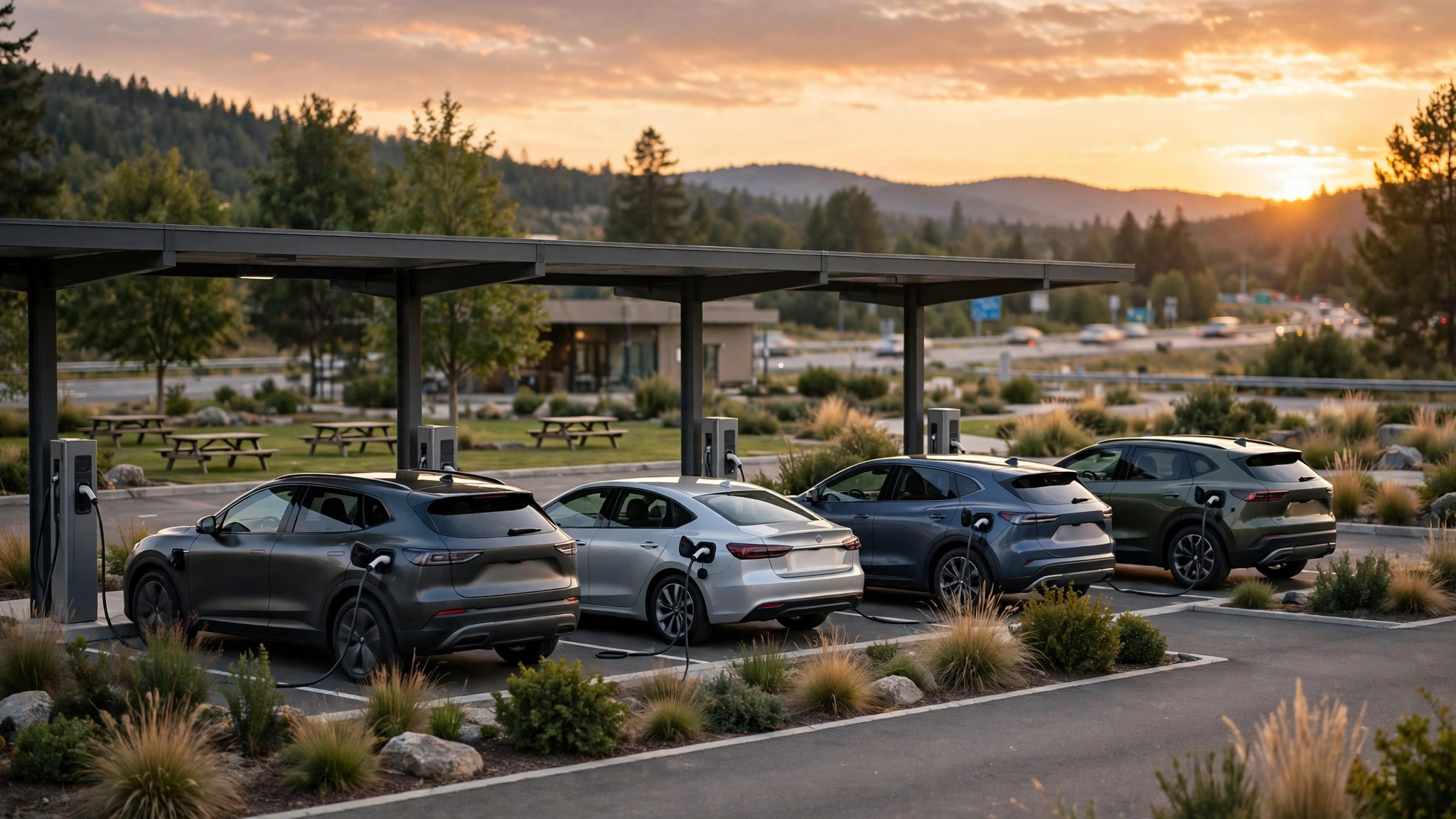
A petrol queue wastes minutes; a charging queue can waste an hour, because the car ahead of you is not there for four minutes — it is there for thirty. That is why EV charging station busiest times matter more, per vehicle, than any other crowd pattern in this series, and why learning the charging curves is now a basic EV ownership skill. The patterns are young but already clear: public chargers follow the road trip, the commute and the shopping trip, and Google Maps increasingly shows both the chargers and the crowd logic around them.
This guide maps when public chargers are busiest and when they sit idle, explains the queue mathematics that makes one car ahead a serious problem, and shows how to build charging into a trip so the queue never happens. It pairs with our guide to petrol station busiest times — the mirror image, where queues are shorter but stations more numerous — and with our explainer on parking in a busy area, since a charging bay is, in the end, a parking space with a cable.
EV charging station busiest times on a road trip
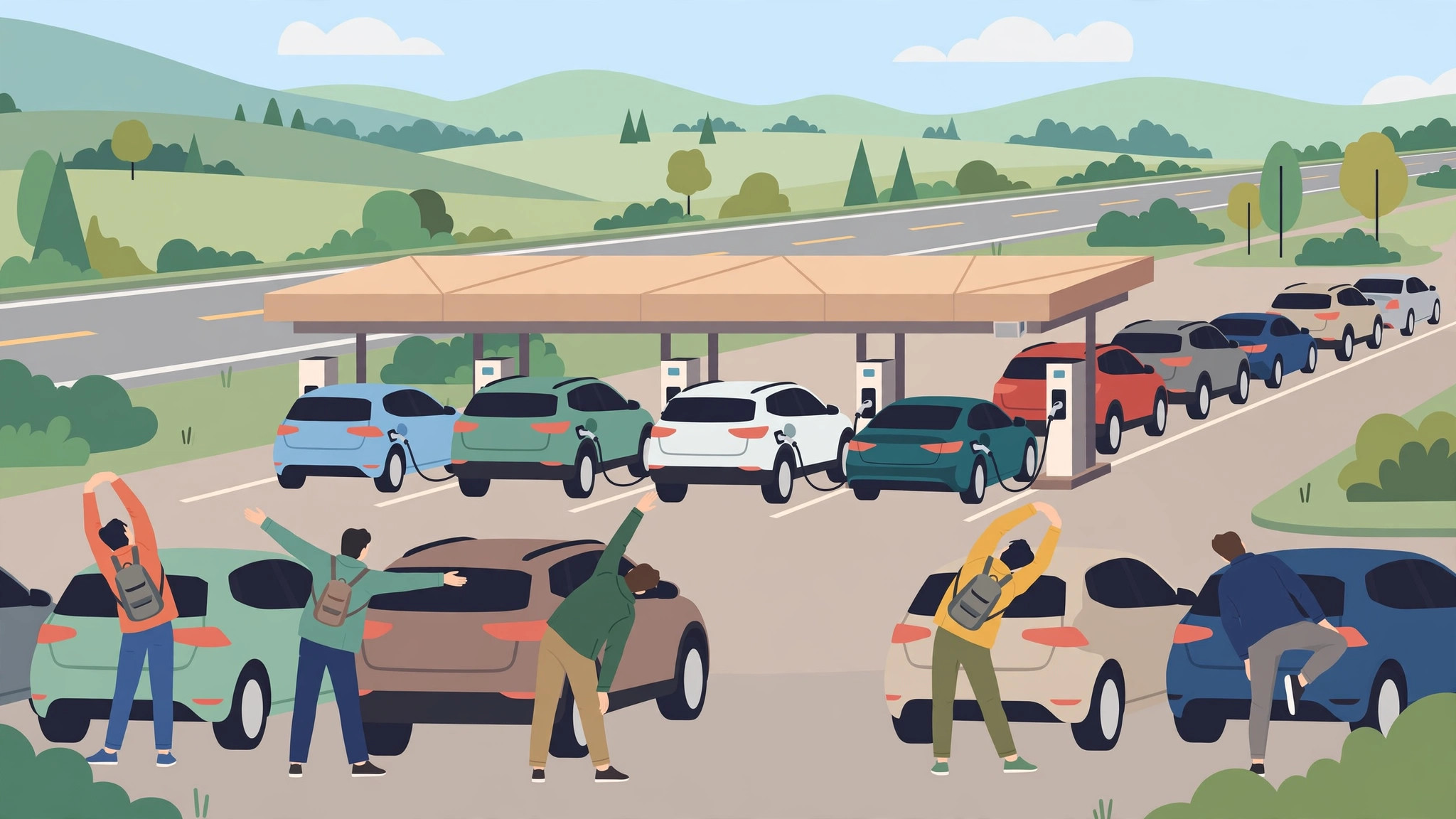
Highway fast chargers live on the travel calendar. Their peaks arrive in waves behind the traffic: a mid-morning wave as the first long-distance drivers of the day reach their first stop, an early-afternoon wave, and the day’s biggest wave in the late afternoon as everyone tries to charge before the final leg. Friday afternoons and Sunday evenings — the getaway and return peaks — are the worst slots of the week at corridor chargers, and holiday weekends multiply them.
The wave structure creates the road-tripper’s key insight: charger peaks lag the live traffic peaks by roughly the time it takes to drive the first leg. Leaving an hour earlier than the crowd does not just beat the traffic; it puts you at the charger before the wave that is driving behind you. Conversely, stopping for your first charge at the same famous services as everyone else, at the same elapsed driving time, is how queues form at exactly the charger you chose. Stopping slightly earlier or later than the natural break point — one exit of discipline — usually finds an empty plug on the same road.
Home, work and public: three different charging curves
Most charging never touches the public network, and the public curve is shaped by what home and workplace charging cannot do. Home charging happens overnight and invisibly. Workplace chargers peak with the working day and are effectively a private system for the people in the building. The public network serves the gaps: apartment dwellers without home charging, drivers on long trips, and top-ups during shopping and leisure.
That is why town-centre and retail-park chargers peak with the shops — Saturday late morning and weekday evenings — while chargers at gyms, cinemas and restaurants peak with those venues. Destination chargers inherit their host’s crowd curve almost exactly, which means the popular times graph of the host venue is a genuine forecast for its chargers. A charger at a Saturday-peak shopping centre will be contested on Saturday; the same hardware at a business park sits empty all weekend.
The queue maths: why one car ahead is thirty minutes
Charging has a queueing property petrol never had: service time is long and variable. A fast-charge session runs roughly twenty to forty minutes depending on the car, its battery size and how full the driver wants it. One car ahead of you at a single charger is therefore not a four-minute wait but a half-hour one, and two cars ahead can exceed the entire time you planned to stop.
Three consequences follow. First, charger count matters more than charger speed in a queue: a site with six plugs clears a crowd six times faster than a single-plug site, whatever the headline kilowatts. Second, the last percentage points are the queue’s enemy — charging slows dramatically near a full battery, so the driver ahead who insists on 100% doubles your wait; the etiquette of stopping at 80% on a trip is really queue management. Third, checking before you commit is essential, because arriving at a busy single-plug site with a low battery leaves you no options. Range in reserve is queue insurance.
The empty hours: when chargers sit idle
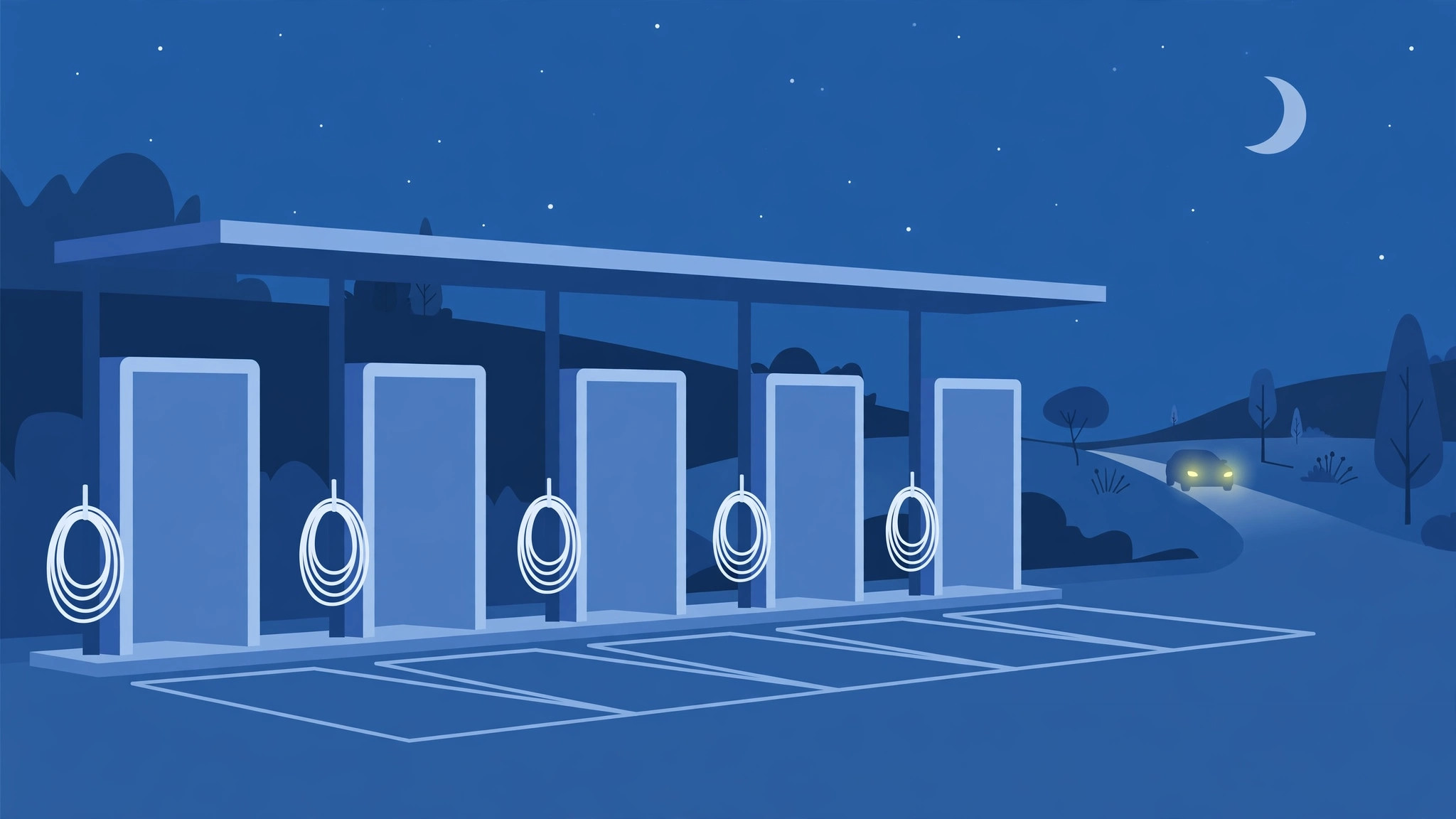
The same network that queues on Friday afternoon is mostly empty at other times. Weekday mid-mornings and mid-afternoons at urban chargers are reliably quiet. Overnight, public chargers at retail sites sit unused, though access hours may not allow their use. Weekend early mornings — before the shopping and leisure waves — are the road-tripper’s friend at corridor sites too.
For drivers without home charging, the empty hours define the routine: a weekly charge in a quiet weekday window, combined with a destination charge while doing something else, covers most driving without ever joining a queue. The public network’s problem is not capacity — it is concentration, everyone arriving in the same few hours. Spreading into the empty hours is something each driver can do unilaterally, and it works immediately.
Checking charger busyness before you go
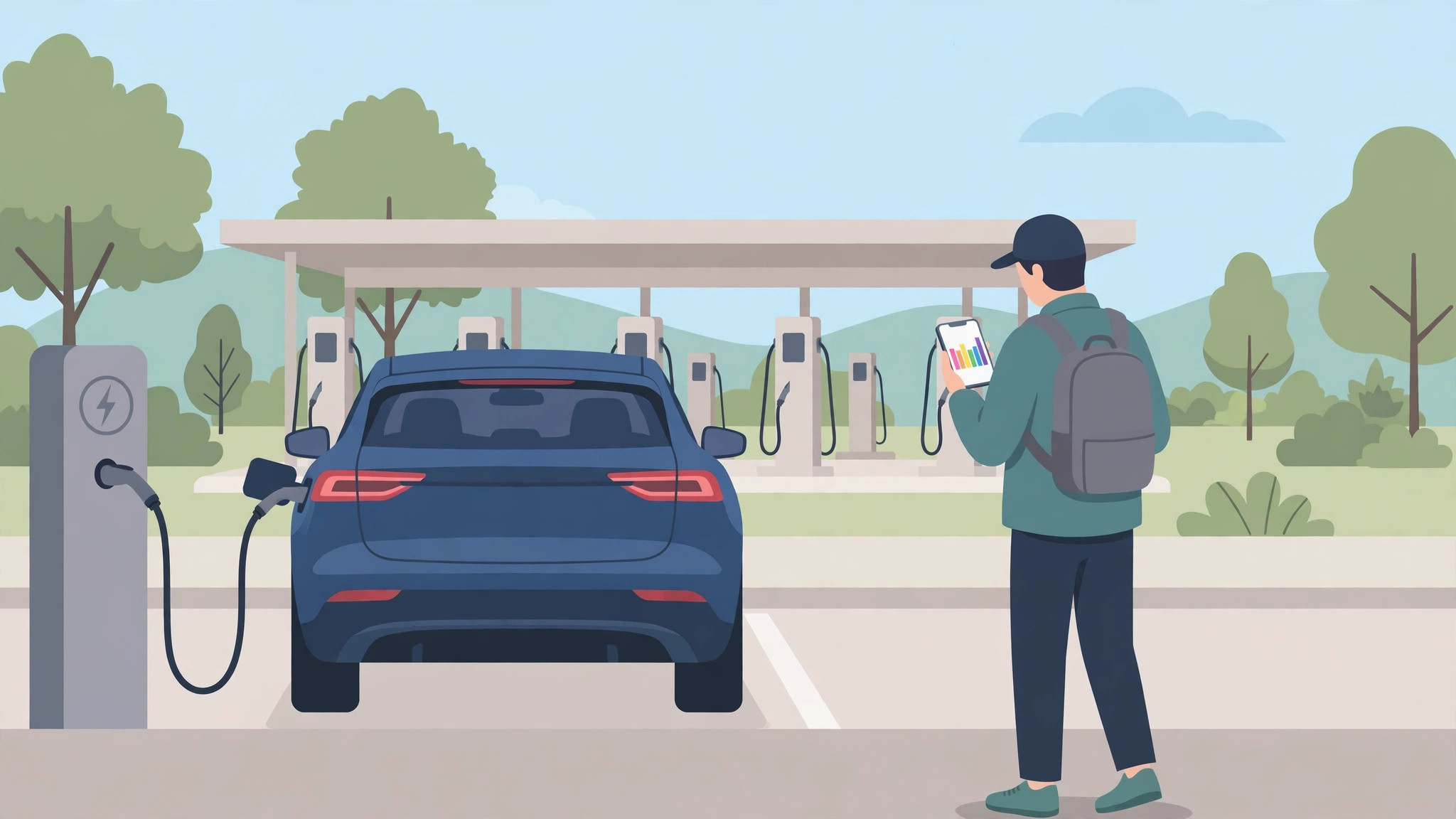
Live charger availability is better data than busyness: many networks report each plug’s status — available, in use, out of service — to apps and to Google Maps for supported networks. The checking routine for a trip:
- In Google Maps, search for charging stations along the route and check the station listing; for many networks the listing shows connector types and, where reported, live availability.
- Cross-check in the network’s own app, which usually has the freshest plug-level status and can start the session.
- Plan the stop one exit off the obvious choice, and keep a second charger identified as a fallback within range.
- Check the host venue’s popular times for destination chargers — a busy venue means contested chargers.
The US Department of Energy’s Alternative Fuels Data Center station locator is a reliable way to verify a charger’s existence, network and connector types before a trip into unfamiliar territory — useful because a charger that exists on paper but is out of service is the one failure mode no crowd data can warn you about.
India: swapping, slow chargers and the highway build-out
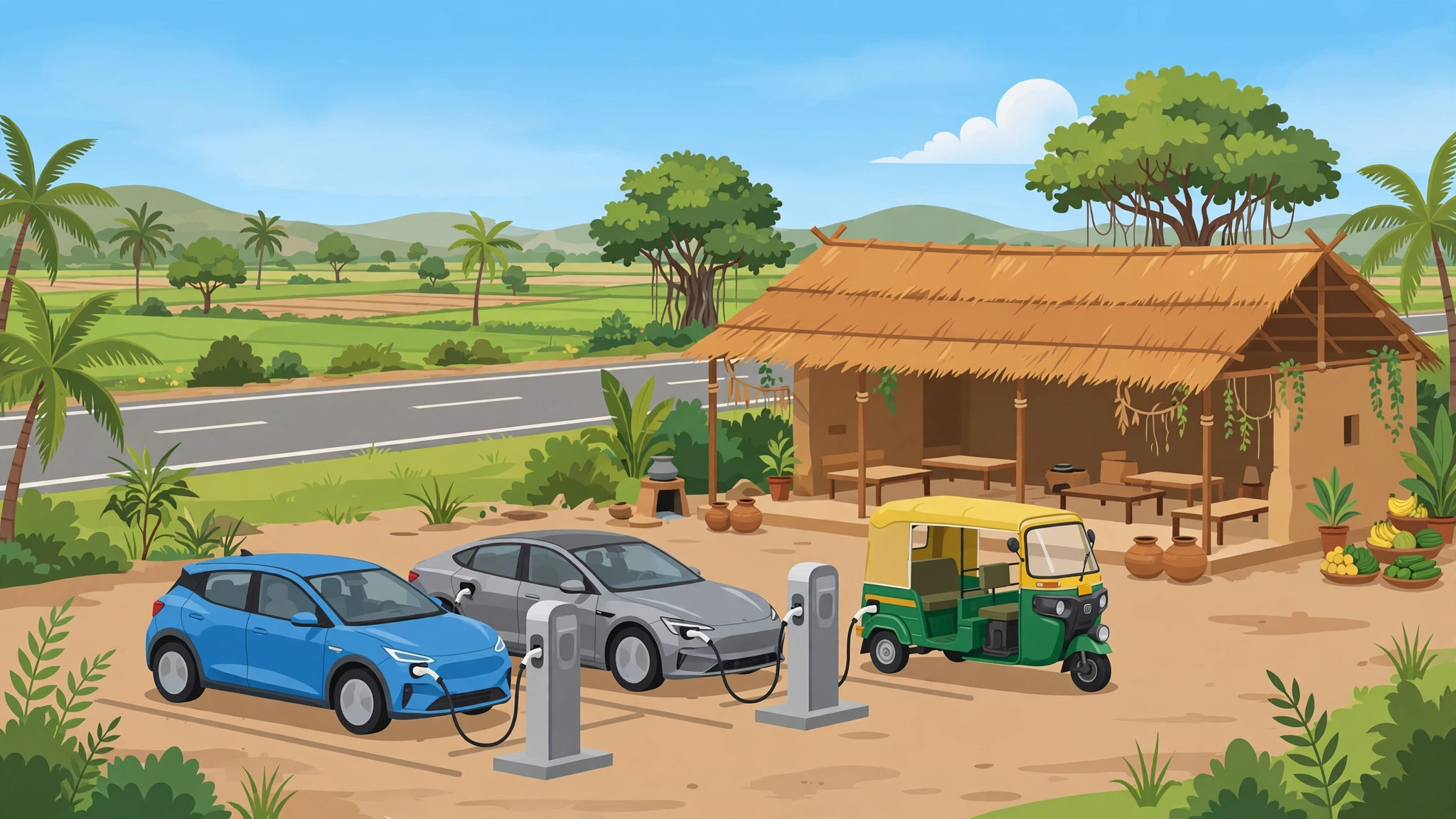
India’s public charging pattern is still forming, with two distinctive features. Battery-swapping stations for two- and three-wheelers create a different rhythm entirely — swaps take minutes, so their queues behave like petrol queues, peaking with delivery and auto-rickshaw working hours. Car fast-charging on highways is concentrated at a small number of sites on the busiest corridors, which makes the Friday and holiday waves sharper than in mature networks: everyone on the Delhi–Jaipur road on a Friday evening wants the same few plugs.
In cities, mall and office-park chargers follow their hosts, and a growing share of charging happens in residential societies overnight. The practical advice for Indian EV drivers mirrors the global pattern with extra emphasis: on corridor trips, charge earlier than the crowd and never plan to arrive at a single-plug site on empty.
Workplace, fleet and taxi charging: the weekday undercurrent
Underneath the public peaks runs a weekday undercurrent of commercial charging. Depot and workplace chargers serve fleets that return on a schedule — delivery vans in the evening, pool cars at close of business — and those sites can be at their busiest when the public network is quiet. Taxi and ride-hail drivers, who cannot charge at a depot, use public fast chargers in the troughs of their own working day: late morning and mid-afternoon, between the commute peaks they serve. That is one reason urban fast chargers show a small mid-day bump on weekdays that pure private-car logic would not predict.
For the private driver, the undercurrent matters at shared sites: a charger near offices may be free at noon but contested at 6 pm by returning fleet vehicles, and an airport-area charger follows the flight banks rather than the shops. The host-and-neighbour rule still applies — a charger’s crowd is the crowd of whatever brings cars to that spot, working or leisure.
When you arrive at a full site: the EV driver’s options
Sooner or later every EV driver arrives at a full charging site with a low battery. The options, in order of wisdom: check the network app for the session state of the plugs in use — a car at 92% is minutes from leaving, a car at 40% is not. Look for the queue’s informal order; at busy sites drivers usually know who is next, and joining that understanding politely is the system that exists until formal queueing arrives. Recalculate your fallback charger while you wait, because waiting thirty minutes for a plug and then charging for thirty is only rational if no alternative site is within your remaining range.
And if the wait is genuinely long, reconsider the plan: a slower charger nearby that is free now — an AC post at a supermarket or car park — can deliver more energy in the next hour than a fast charger you reach after queuing. Slow and now routinely beats fast and later, which is the charging version of this series’ oldest lesson: the best crowd is the one you are not in.
Slow destination chargers: the crowd you choose on purpose
Not all public charging is a queue risk. Slow AC chargers at car parks, hotels, cinemas and shopping centres work on a different principle: the car charges while you do something that takes hours anyway. These posts are rarely all occupied outside their host venue’s own peak, and their “busyness” is simply the venue’s parking busyness. Choosing a destination charger means choosing the venue’s crowd curve as your charging curve — which is a good trade at a quiet weekday cinema and a poor one at a Saturday-peak mall. Check the venue’s popular times, and the charging plan makes itself.
A charging routine that never queues
Put the patterns together and the queue-free routine designs itself. Home or workplace charging carries the week wherever it exists. Public top-ups go into the quiet windows — weekday mid-mornings, early weekend mornings — or hide inside other activities at destination chargers timed to the venue’s quiet hours. Road trips leave ahead of the wave, stop off the natural break point, favour multi-plug sites, and charge to 80% and go. The live availability check happens before the battery forces your hand.
EV charging station busiest times are, in the end, travel times and shopping times wearing new clothes. The network is emptiest exactly when the roads and shops are — and the EV driver who learns the old crowd curves gets the newest infrastructure almost to themselves. That is the quiet bargain of the electric transition: the chargers were built for the peaks, but they belong, most hours of the week, to whoever plans around them.
