
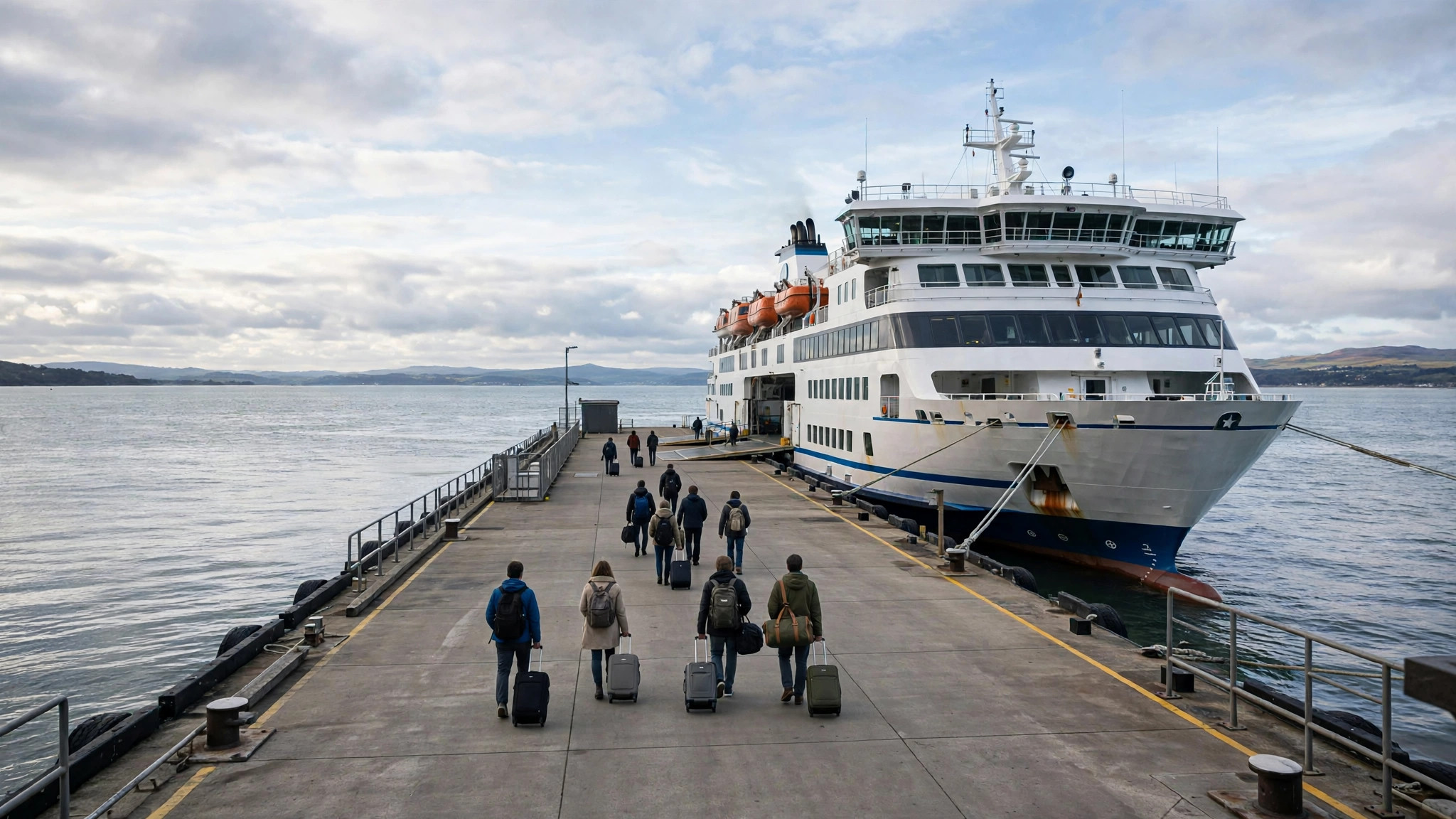
Every other crowd in this series flows; the ferry crowd pulses. A ferry terminal can be empty at noon and impassable at 12:40, because its crowd is not generated by the hour of the day but by the timetable: hundreds of people converging on a single departure, then vanishing onto the water. Ferry terminal crowd times therefore break the rules that govern shops and stations, and the popular times graph of a terminal needs a completely different reading — one this guide will teach you.
Whether you are a foot passenger with a rucksack or a driver joining the vehicle lanes, the winning strategy is the same: understand the wave, and position yourself relative to it. The comparison pieces in this series are our guides to airport busiest times — the other timetable-driven crowd — and parking in a busy area, because every ferry wave begins as a parking wave at the port.
Ferry terminal crowd times follow the timetable
A shop’s graph is a smooth hill; a ferry terminal’s graph is a row of spikes. Each spike has the same anatomy: it begins rising as the check-in window opens, steepens as the departure approaches, and collapses within minutes of the sailing. Between sailings, the terminal returns to near-empty, however large the day’s total traffic. This is why a terminal’s “busiest hour” is almost meaningless without the timetable beside it — the graph is really a picture of the sailing schedule wearing crowd data.
Three variables set the height of each spike. The vessel’s capacity sets the maximum crowd. The route’s popularity sets how full the sailing runs. And the check-in deadline sets how compressed the arrival wave is: a route that closes check-in forty-five minutes before departure pulls its whole crowd earlier and tighter than one that boards until the last ten minutes. When you read a terminal’s curve, you are reading those three numbers in disguise.
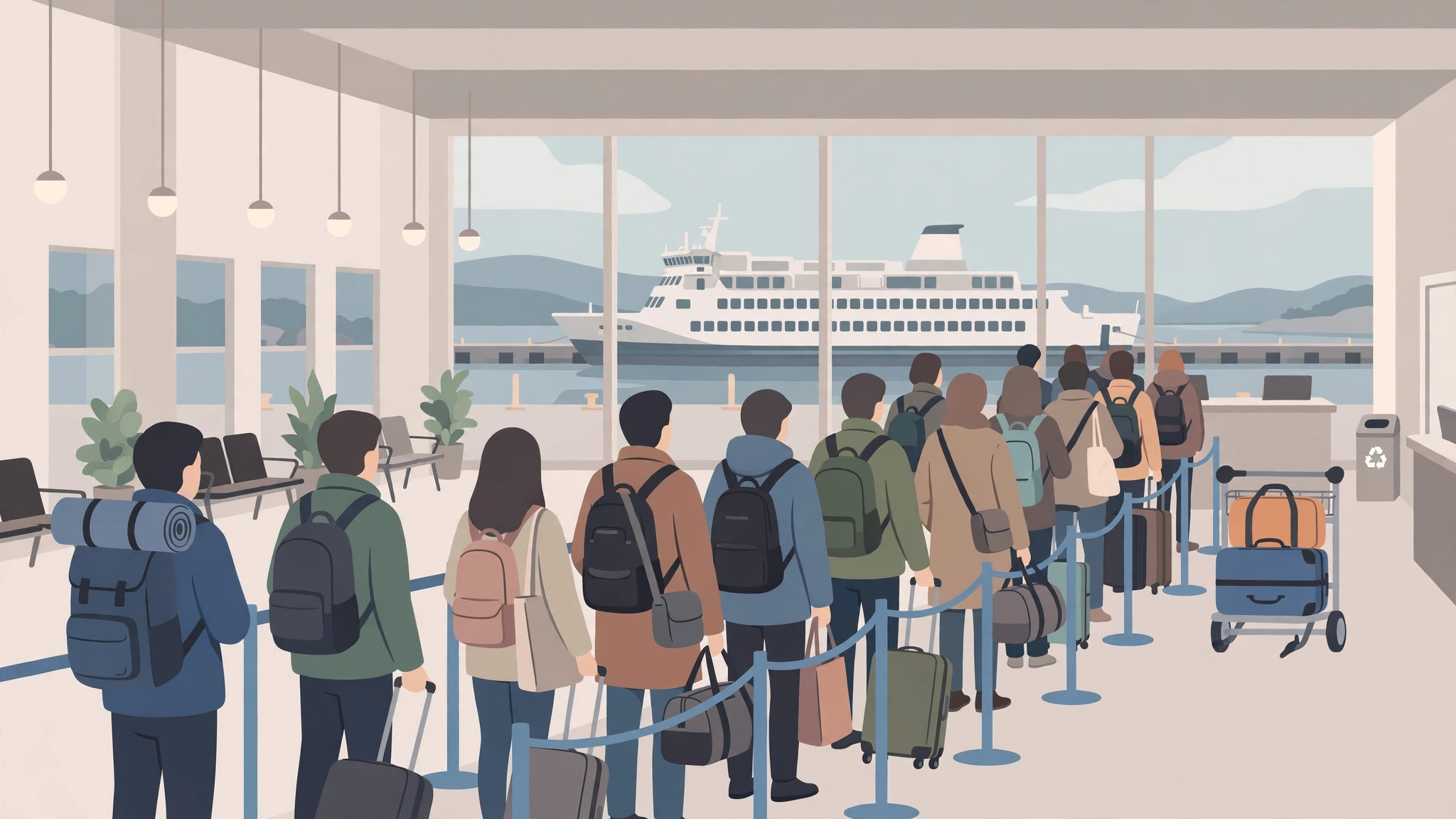
The check-in surge: ninety minutes of crowd
Within each spike, the crowd is not evenly spread. Vehicle traffic arrives first and over the longest window — drivers are told to arrive early, and freight arrives earlier still. Foot passengers arrive later and faster, with the sharpest surge in the final hour before the check-in deadline. Inside the terminal, the queues form in sequence: ticket and check-in desks first, then security and document checks, then the departure lounge, which fills and empties like a lung with each sailing.
The practical consequence is that terminal time is a trade. Arriving at the front of the wave means short queues but a long wait in the lounge. Arriving at the deadline means no lounge wait but the full queue at every desk and the real risk of missing the sailing if anything snags. The experienced traveller aims for the middle of the wave — after the opening surge of the earliest arrivers, before the deadline rush of the latest ones. On busy routes and holiday weekends, shift that aim earlier: waves grow in both height and width, and the middle moves.
Commuter ferries vs holiday routes
Two route types produce two different weekly shapes. Commuter ferries — harbour crossings, river services, island commutes — behave like floating metros: twin weekday peaks in the morning and evening, quiet middays, and a weekend lull. Their crowds are regulars, queues are disciplined, and the popular times graph is a faithful guide.
Holiday and leisure routes invert the pattern. Their peaks sit on Friday and Sunday sailings, at the start and end of school holidays, and around festivals and events on the far shore. A route to an island with a famous festival can run its year’s biggest crowd on a single weekend, and mid-season weather matters too: the first sunny weekend after a rainy spell sends the graph somewhere the timetable alone would never predict. For leisure routes, the calendar of the destination — its holidays, events and seasons — is as much a crowd forecast as the timetable.
Cars, foot passengers and freight: three queues, one terminal
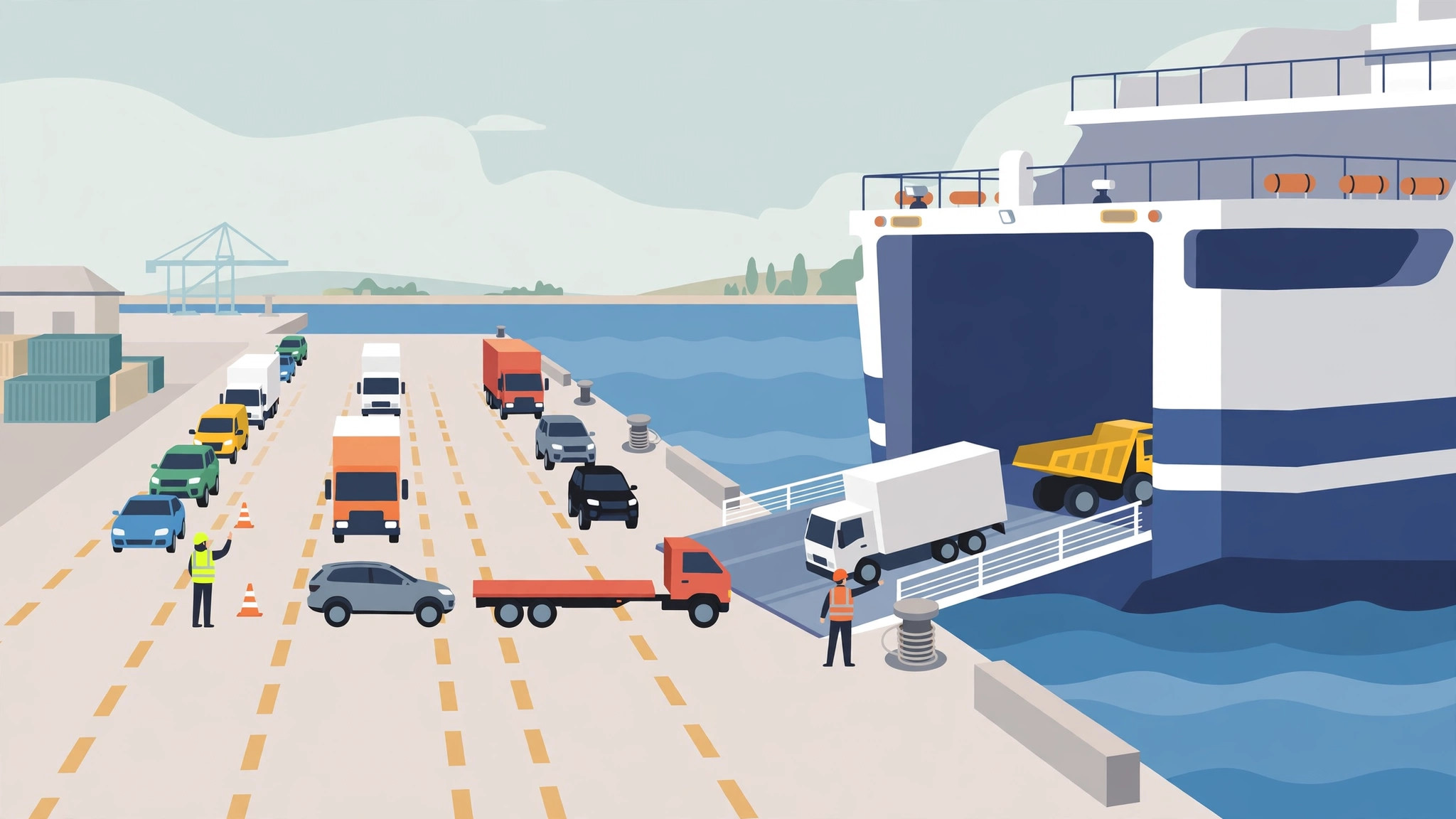
Ferry queues are plural. Vehicle lanes move slowest per person but start earliest; foot passengers move fastest but arrive latest; freight runs to its own schedule and can clog the vehicle lanes before passenger check-in even opens. The terminal’s single popular times curve blends all three, which is why a foot passenger can find a “busy” terminal perfectly comfortable — the crowd is in the vehicle lanes — and why a driver can find a “moderate” terminal miserable when freight peaks early.
Read the graph through your own queue’s lens. Drivers should weight the early part of each spike; foot passengers the late part. And if your route offers foot-passenger-only sailings or fast craft alongside the car ferry, their terminals and curves are separate listings worth checking individually — the foot ferry at the same hour is often the calmest way across the same water. Travellers looking for what is around the port before a sailing can also use our guide to busy areas near me to time a meal or errand in the port district against the same wave.
Reading a ferry terminal on Google Maps
Terminals usually carry listings with popular times, and harbours and port districts can carry the area busyness label as well. The checking routine:
- Read the terminal’s graph for your sailing’s hour, but interpret it as a wave position, not a crowd level — early in the spike is calm, late is not.
- Compare the same sailing on different days; on leisure routes, the Friday and Sunday versions of the same departure are different worlds.
- Check the live reading on the day, especially in the hour before your check-in deadline, when the wave is actually forming.
- Look at the approach roads on the traffic layer; a port’s vehicle queue shows up there before it shows up anywhere else.
Google explains how its live and historical busyness data works in the Google Maps Help documentation — the historical graph gives you the timetable’s shape, and the live reading tells you where today’s wave has got to.
India: RoRo ferries, river crossings and the holiday rush
India’s ferry map is varied: RoRo services carrying cars across bays and rivers, passenger ferries to islands off Mumbai and Kolkata, river crossings in Assam and Kerala, and the Andaman and Lakshadweep ship services. The crowd logic is the same, with Indian seasoning. Commuter crossings like Mumbai’s harbour ferries take the office peaks. The Alibag and island leisure routes take weekend and holiday waves that can overwhelm small terminals, where the queue spills out of the building entirely. Monsoon season suspends or thins many services, compressing demand onto the sailings that do run — and onto the first clear-weather weekend after a stormy spell, which behaves like a festival weekend in crowd terms.
Port formalities for the island ship services add an airport-like layer: document checks and luggage screening pull the arrival wave earlier and make the middle-of-the-wave strategy more valuable, because the cost of the deadline rush is a missed ship, not a missed train.

International ferries and port formalities
Cross-border ferry routes add an airport’s machinery to the terminal: passport control, customs, and for vehicle traffic, document and security checks on the cars themselves. Formalities pull the arrival wave earlier — operators typically ask international passengers to arrive well before the domestic check-in deadline — and they lengthen it, because each desk’s queue clears at a different speed. The graph of an international terminal shows broader, earlier spikes for exactly this reason.
The traveller’s adjustment is simple: on an international sailing, your wave position shifts earlier by the length of the formalities. The middle of the wave is no longer an hour before departure but closer to ninety minutes or two hours, and the deadline rush at passport control is the one queue in ferry travel that can genuinely cost you the sailing.
When sailings cancel: the crowd that stays
A cancelled sailing creates the terminal’s worst crowd: two departures’ worth of passengers, one building’s worth of space. Weather cancellations cluster — a stormy day cancels the morning sailing, whose passengers rebook onto the afternoon one, whose own crowd was already coming. Small terminals feel this acutely, and the information queue at the ticket desk becomes the longest line in the building.
The defence is to engage early and remotely: check the operator’s sailing status before leaving for the port, rebook from home rather than at the desk where everyone else is rebooking, and if you must travel on a disruption day, take the first sailing that runs rather than the one nearest your plan. The graph will still show a normal day. Days at sea do not read the graph either.
Day-trippers and excursion boats: the leisure wave
Below the scheduled ferry network floats a second one: excursion boats, island day-trip services and harbour cruises. Their crowd is a pure leisure wave — a single morning departure peak as day-trippers board, an evening return peak, and nothing in between. These services often leave from small piers with no real terminal, so their queue lives on the jetty and the ticket kiosk, and their graph, if the listing has one, shows just two spikes on fine weekends and nothing at all on rainy ones.
The day-tripper’s crowd strategy is the mirror of the commuter’s: the first boat out and the last boat back are the crowded ones, chosen by everyone with the same idea. The second boat out and the second-to-last back carry the same view at half the density.
Working boats: freight, mail and the island lifeline
Not every sailing is for passengers. Island and coastal communities are served by working boats whose crowd is cargo: supplies going out, produce and fish coming back, mail and medicine in both directions. Their terminals peak at loading time, often early in the morning, and the passengers they carry ride in a system paced by freight. If your journey uses a lifeline service, its crowd follows the island’s needs — market days, supply days, hospital appointment days on the mainland — a calendar the islanders know by heart and the visitor learns by asking.
A calm-terminal routine
The routine writes itself once the wave is understood. Book the sailing, not just the day — walk-up passengers inherit whatever wave the booked crowd has already built. Arrive in the middle of your wave: after check-in opens and the first surge clears, comfortably before the deadline. On holiday routes and festival weekends, arrive a wave-position earlier than instinct suggests. Drivers: the vehicle queue is the longest, so your “middle of the wave” is earlier than a foot passenger’s. And keep the return sailing’s wave in mind when planning the far-shore day, because the evening return peak is the one that strands people.
Ferry terminal crowd times are the purest timetable crowds in travel. Nobody drifts into a ferry terminal; everyone there was summoned by the same departure. Learn to see the wave on the graph, place yourself in its calm middle, and the terminal stops being a lottery — it becomes the most predictable crowd of the whole journey.
