

A coffee shop can go from serene to slammed in fifteen minutes, and the shape of that surge is so regular you could set your watch by it. Understanding coffee shop busiest times means understanding the morning-rush curve: the commuter spike, the mid-morning laptop plateau, the lunch bump and the long afternoon exhale. Google Maps shows the curve for your specific café in its Popular Times graph, and chain locations such as Starbucks often show a live bar as well — so the queue is one of the most avoidable in daily life.
This guide walks through the curve hour by hour, explains why coffee shops peak the way they do, and shows how to time your visit — or your mobile order — for the gaps. As with every pattern on this site, treat the timings as typical and confirm them on your café’s own listing, because a café inside a station, an office tower or a mall follows its building’s clock as much as its own.
When are coffee shops busiest and least busy?
Coffee shops are busiest on weekday mornings between about 7 AM and 9:30 AM, when the commuter rush and the school-run stop overlap, and again in a smaller lunchtime bump between 12 PM and 2 PM. Weekend busiest times arrive later and last longer: a broad brunch-era peak from about 9:30 AM to 1 PM on Saturdays and Sundays.
They are least busy in the mid-to-late afternoon, roughly 2:30 PM to 4:30 PM on weekdays, once the lunch crowd has gone and before the after-school and early-evening trickle. The first half hour after opening and the last hour before closing are also reliably calm at most cafés — the morning’s first customers are few, and the day’s last ones have usually had their coffee hours ago.
Between those poles sits the feature that makes coffee shops unique: the laptop plateau. From about 10 AM to noon, many cafés fill with remote workers and students who order once and stay for hours. The queue at the counter may be short while every table is taken — a distinction the busyness graph alone cannot make, and one worth remembering if you need a seat rather than a cup.
Anatomy of the morning rush
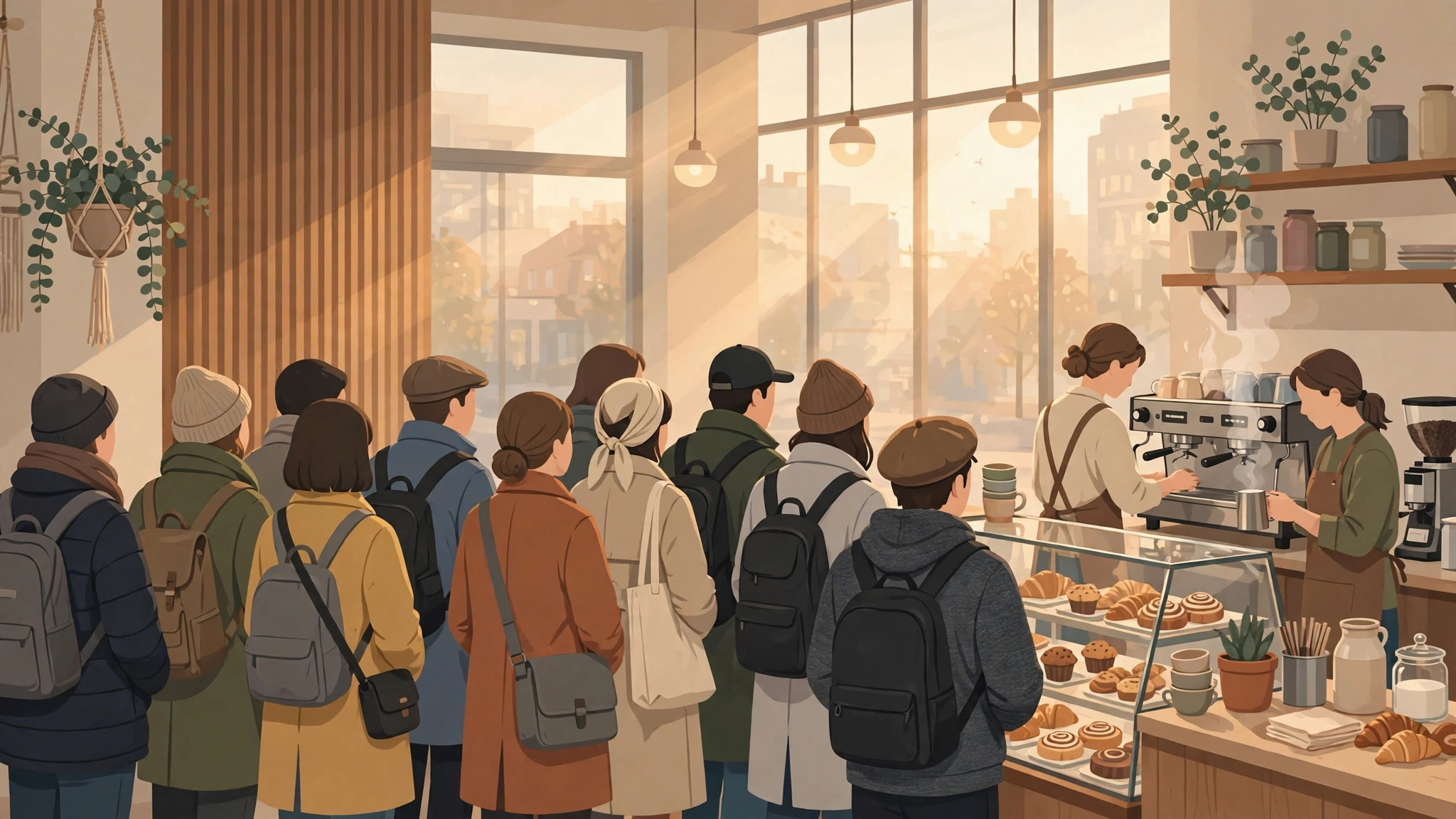
The morning rush is really three rushes stacked. The first wave (opening to about 7:30 AM) is shift workers, early commuters and regulars with standing orders — fast, practised and gone quickly. The main wave (7:30 AM to 9 AM) is the peak proper: commuters in transit, parents after the school run, and office workers grabbing coffee on the way in. This is when the queue reaches the door and the mobile-order shelf fills up. The tail (9 AM to 10 AM) is the flexible-workers’ hour — people whose first meeting is at ten, treating the café as the day’s soft start.
The practical lesson is that the rush has soft edges. Arriving at 7:15 AM instead of 7:45 AM, or holding your coffee run until 9:20 AM, routinely halves the wait without changing your morning by much. The graph on the listing shows exactly where your café’s edges sit — the general method for reading it is the same one we teach for how busy a restaurant is, applied to a faster, smaller room.
Starbucks and the mobile-order effect
Big chains add a twist: mobile ordering. At a busy Starbucks, a large share of drinks are ordered ahead in the app and collected from a pickup shelf. This changes the crowd in two ways. The visible queue at the till understates how busy the bar actually is — the baristas may be working through a long invisible queue of app orders. And the crowd at the pickup area can be the densest spot in the store even when seating is free.
For customers, the tactic follows naturally: if the live bar says the store is slammed, order in the app earlier than feels necessary, or choose the chain’s quieter nearby branch — chains cluster, and a two-minute walk often crosses from the busiest store in the district to a calm one. For walk-in customers at peak, the in-store queue is sometimes genuinely faster than the app’s estimate, because you can see the shelf and judge. Regulars learn their own store’s behaviour within a few visits; the graph shortens the learning curve.

Weekends, malls and stations: three special clocks
Weekend cafés follow leisure time. The peak starts later, stretches longer, and mixes coffee with breakfast and brunch, so visits are longer and tables turn slowly. A Saturday 11 AM queue is not a queue of commuters in a hurry — it moves at brunch speed.
Mall cafés inherit the mall’s curve: quiet at opening, building to the early-afternoon maximum we map in our guide to mall food court busiest times, and easing towards closing. Their morning rush barely exists, because the mall around them is still shut or empty.
Station and airport cafés pulse with departures rather than hours. Their peaks break into waves a few minutes before each cluster of trains or flights, with strange lulls between. If your café is inside a hub, the live bar is worth more than the graph, because timetables — and delays — rewrite the day in real time.
Using Popular Times to plan your coffee
A simple routine gets the most from the data. Check your café’s graph once for each day type you care about — your workday pattern and your Saturday pattern are the two that matter. Note the lull you can actually use: for many office-area cafés it is the 2:30 PM to 4 PM window, which is also when baristas have time to make the complicated drink properly. Then use the live bar tactically: on days when a meeting, a match or the weather has bent the pattern, the live reading catches what the graph cannot.
The district signal helps too. When the whole surrounding area shows as busy on the map — the orange shading explained in our Busy Area pillar guide — every café in it is busy together, and the correct move is to a café outside the shaded zone rather than a different one inside it.
The coffee run playbook: quiet windows at a glance
For a typical weekday café in a mixed or office neighbourhood, the day usually resolves into these windows:
- Opening – 7 AM: calm. Regulars and shift workers only.
- 7 AM – 9:30 AM: the rush. Longest queues, slowest drinks, fullest pickup shelf.
- 9:30 AM – 12 PM: the laptop plateau. Short queue, few free tables.
- 12 PM – 2 PM: the lunch bump. Busy again, but faster-moving than the morning.
- 2 PM – 4:30 PM: the lull. The quietest, most relaxed stretch of the day.
- 4:30 PM – closing: a gentle trickle — school-run parents, students, and the last remote workers packing up.
Weekends compress this into a later, longer shape: a slow start, a heavy 9:30 AM–1 PM block, and a gradual afternoon fade. Pin this playbook against your own café’s graph once, adjust the boundaries to its actual bars, and you have a personal timetable that will serve you every week.

Drive-thru queues and the two-line problem
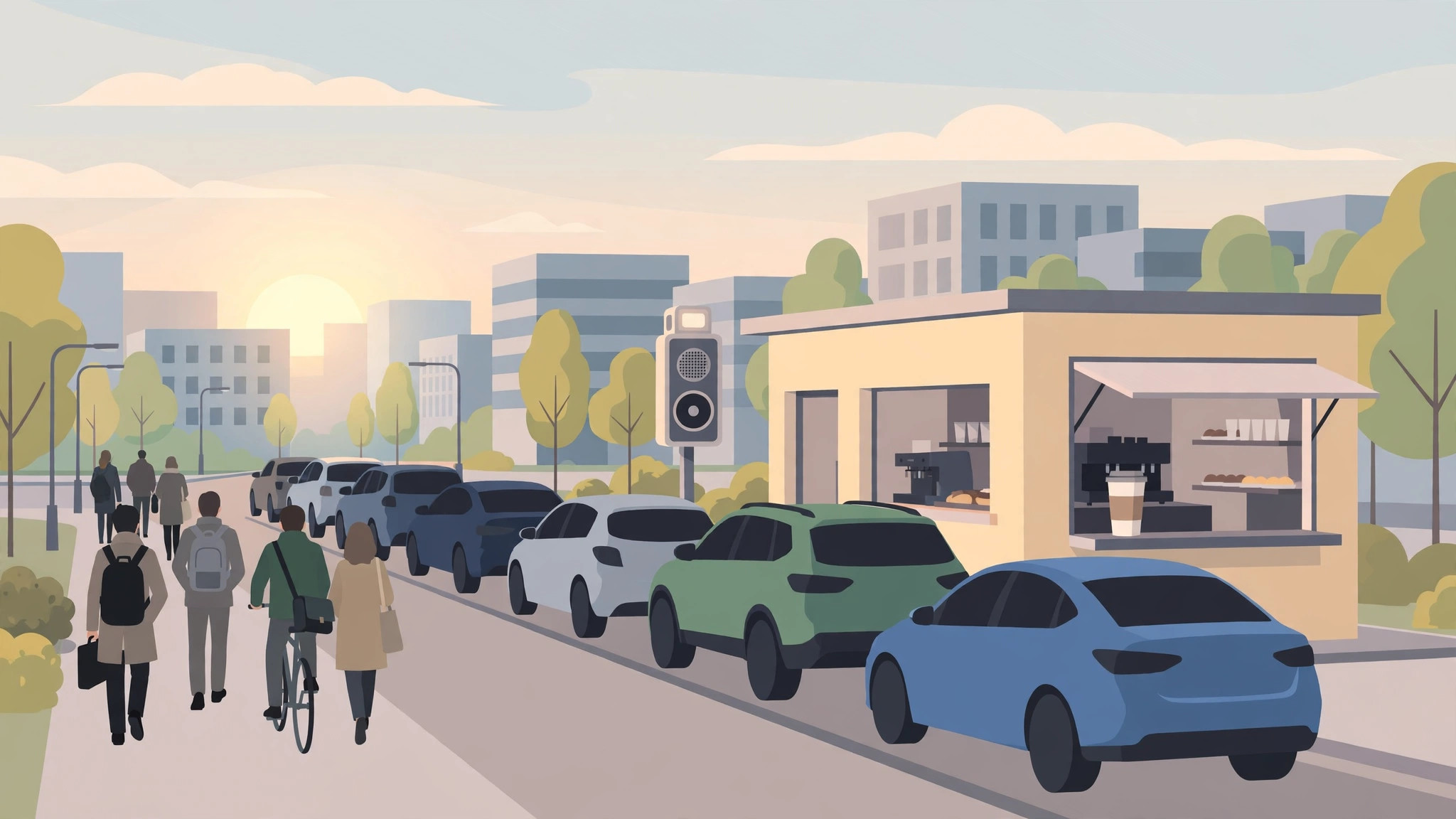
At drive-thru locations, busyness splits into two lines that the listing cannot fully separate: the cars outside and the customers inside. The Popular Times bar describes the location as a whole, while your actual wait depends on which line you join. A few observations from how these stores behave at peak: the drive-thru line peaks harder at the morning rush, because commuters will not leave their cars; the in-store counter is often the faster option between about 7:30 AM and 9 AM, despite looking busy; and mobile orders complicate both, feeding the same baristas from a third, invisible queue.
If the live bar is at its maximum and you can see the drive-thru wrapping around the building, believe your eyes over any single number, park, and go inside — or take the hint entirely and use the independent café two streets away, whose morning rush is real but smaller. Local knowledge compounds here: one week of watching your regular store teaches you which line its graph is really describing.
The evening second peak: smaller, slower, different
Coffee shops have a second act. After the mid-afternoon lull, an early-evening bump gathers the after-work and after-class crowd — students settling in to study, friends meeting before dinner, remote workers finishing the day somewhere that is not home. It is smaller than the morning rush and behaves differently: people stay longer, order slower, and compete for seats and sockets rather than for the counter. Google’s own data puts coffee shops at their least busy on Tuesday afternoons and their busiest on Saturday mornings, but the evening bump is the one regulars feel, because a full seat map matters more than a short queue when your plan is to sit for two hours.
If the evening session is your ritual, the shoulder of that bump — arriving before the after-work wave or after it thins — is the seat-winning move, and the graph’s evening shoulder is drawn clearly enough to time it.
Frequently asked questions
What is the busiest hour for coffee shops?
On weekdays, the hour around 8 AM in most commuter areas. On weekends, late morning. Your café’s graph shows its own version — office-district cafés peak earlier and sharper than neighbourhood ones.
Is the queue or the seating the real problem at busy times?
Depends on the hour. At the morning peak, the counter queue and the drink wait dominate. During the laptop plateau, you can get a coffee in two minutes and still find nowhere to sit. Say which one you need before you choose your hour.
Do coffee shops show live busyness on Google Maps?
Many do, especially chains and busy independents. Where only the typical graph shows, the pattern is stable enough at cafés that the graph alone is a good guide — Google sets out how these features are generated in its Google Maps Help pages.
When is the best time for a quiet coffee and a long stay?
Weekday mid-afternoon. The rush is gone, the laptop crowd has thinned, and staff are rarely sorry to see a customer settle in until closing.
Conclusion
Coffee shop busiest times follow the most legible curve in everyday life: a sharp morning spike, a working plateau, a lunch bump and a long quiet afternoon. Learn where your café’s spikes sit on its Popular Times graph, step around the edges of the rush, use the app and the live bar at chains, and the daily coffee stops being a queue you endure and becomes the pause it was supposed to be.
