
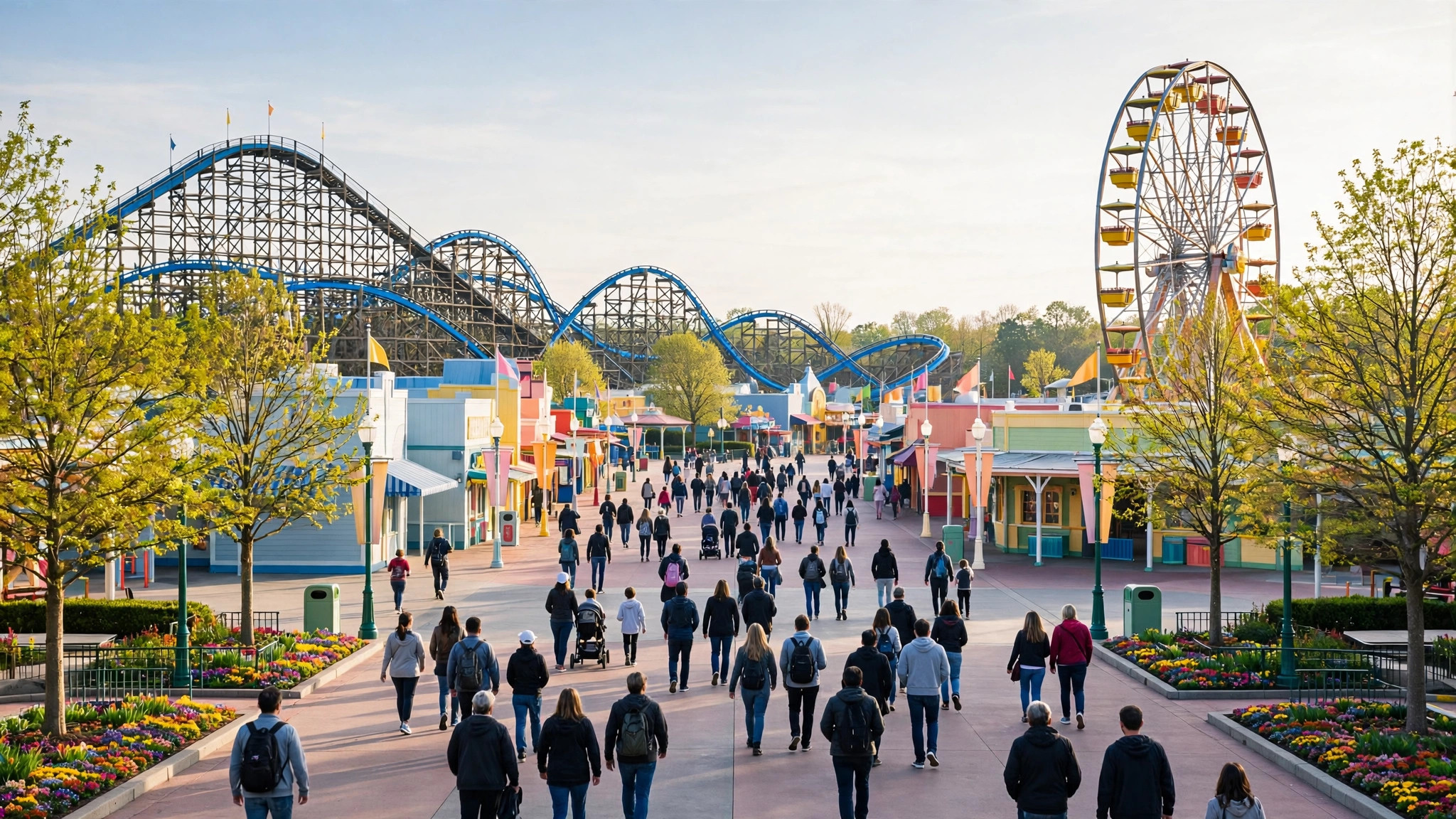
A theme park is the purest crowd problem in leisure. Everyone arrives through the same gates, wants the same five headline rides, and has paid enough that nobody leaves early. Yet two visitors on the same day can have completely different experiences — one spends the day in queues, the other rides everything twice — and the difference is almost never luck. It is timing: which day they chose, and what they did in the first hour. Understanding theme park busiest days, and the strange shape of a park day, is the highest-value planning in all of travel.
This guide covers both halves: choosing the right day on the calendar, and the opening-rush strategy that puts you ahead of the crowd curve once you are inside the gates.
The calendar: which days of the year are busiest
Theme park attendance follows the school calendar more than any other force. The busiest days of the year at most parks cluster into the same windows: the Christmas–New Year stretch, spring break weeks, the summer holiday peak, and long holiday weekends. In India, add the Diwali break, the summer vacation months of May and June, and any regional festival holidays — parks near big cities fill with families making the most of days when schools are shut and offices are closed.
Within an ordinary week, Saturday is the peak almost everywhere, and Sunday runs close behind in the morning before thinning late in the day as people head home for the working week. The quietest days are midweek in school term time: Tuesday, Wednesday and Thursday, when the park’s audience is limited to tourists, shift workers and families with pre-school children.
There is a second, subtler layer: the days immediately before and after a major holiday period are often far quieter than the period itself. The week after schools reopen, or the days just before a festival when everyone is busy preparing, can deliver near-empty parks in good weather. Seasoned visitors plan around these shoulder days deliberately, because the park does not care what the calendar says — it only cares how many people walk in.
The shape of a park day: why the crowd peaks at 2 p.m.
Unlike most attractions, a theme park gets busier as the day goes on, up to a point. Gates open to an early crowd, but arrivals keep streaming in through the morning, and almost nobody leaves before mid-afternoon. The park’s total occupancy therefore peaks in the early-to-mid afternoon, commonly between about 1 p.m. and 4 p.m., when the early arrivals are still inside and the late arrivals have joined them.
Headline ride queues follow the same build. The famous coaster that had a fifteen-minute wait at 10 a.m. can show ninety minutes by 1 p.m. — not because more people chose it, but because the park’s population roughly doubled while ride capacity stayed fixed. After about 5 p.m., the curve bends down: families with small children leave, day-trippers start their journeys home, and queues for major rides can fall by half before the evening.
This shape decides strategy. Everything scarce — headline rides, popular shows with fixed seating, character experiences — should be done at the edges of the day, and everything abundant — gardens, walk-through attractions, shopping, parades you watch rather than ride — belongs in the peak middle.
The opening-rush strategy, step by step
The first hour after gates open is the most valuable hour of the park day, and it is won before you arrive:
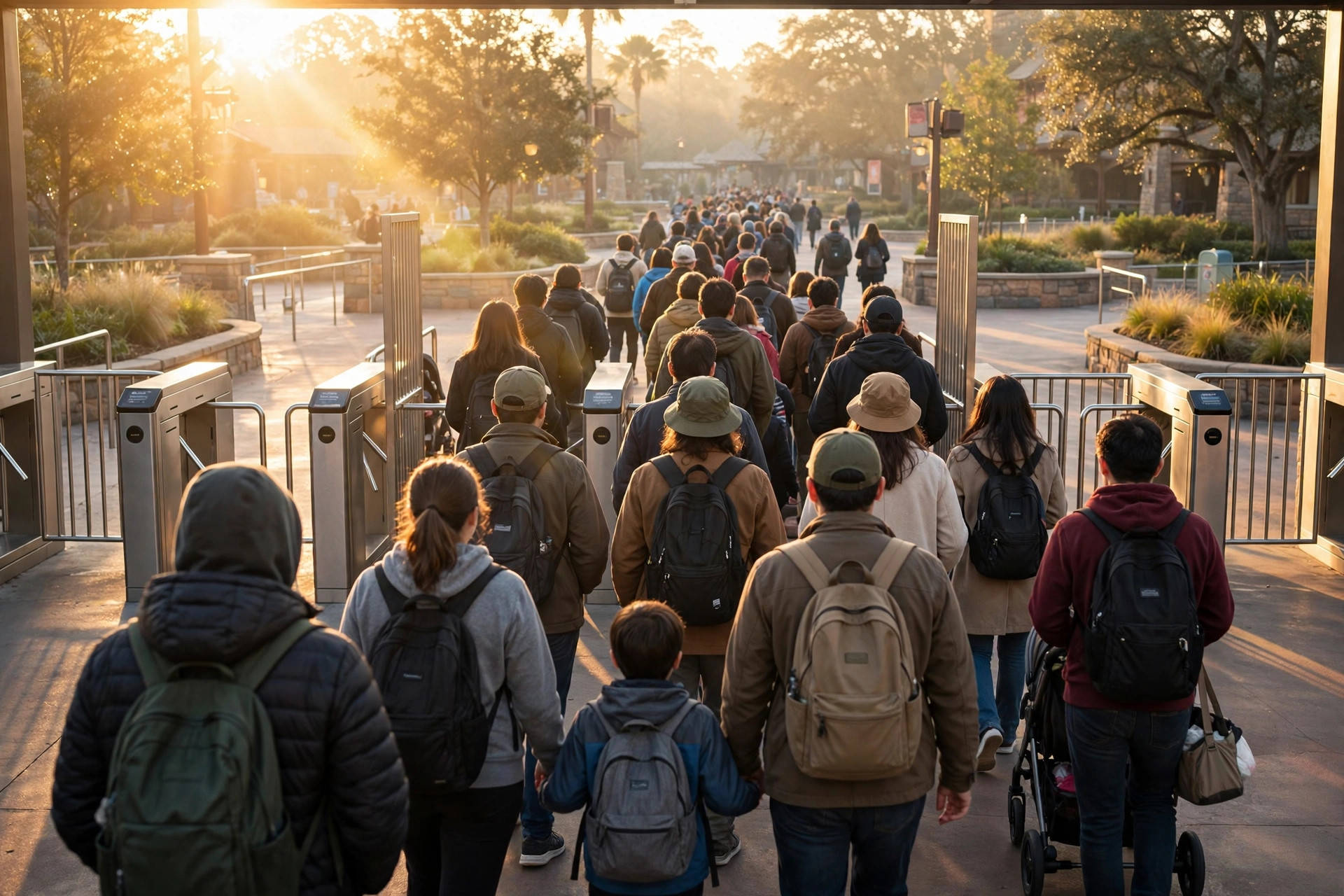
- Be at the gate before opening, not at opening. The queue to enter is itself a crowd. Arriving thirty minutes early puts you in the first wave through the turnstiles instead of behind it.
- Go straight to the headline ride farthest from the entrance. Most visitors ride the first big attraction they see, so queues build from the entrance outward. The far headline ride is reachable in the first minutes and often runs near-empty for the first half hour.
- Work backwards against the flow. After the far rides, move toward the entrance as the crowd moves away from it. You are swimming against the day’s current the whole morning, which is exactly why it works.
- Take lunch early or late. Restaurant queues peak with the ride queues, around 1 p.m. Eating at 11:30 a.m. or after 2:30 p.m. converts a forty-minute food queue into a walk-up — and lets you ride during the lunch hour, when some visitors leave queues to eat.
- Save the afternoon for shows and shade. Fixed-capacity shows absorb crowds efficiently, and the peak hours are the worst time to stand in an outdoor queue in the heat anyway.
- Return to the headliners in the last two hours. As families leave, ride the biggest queues again in the evening fade. Many parks’ final hour offers the second-best riding conditions of the day.
Two supporting habits multiply the effect. First, check whether the park sells any queue-skipping pass and whether its price that day is worth it — on a quiet midweek day it is usually unnecessary, which is another argument for choosing the day well. Second, use the park’s app or board wait times as your live signal, the same way a Popular Times graph guides a city visit; the planning logic in sightseeing with Popular Times applies inside the gates too.
Weather, events and the days that break the pattern
Heat and rain reshape a park day. A forecast of rain scares off local visitors disproportionately — season-pass holders simply choose another day — so a drizzly weekday can be gloriously empty for a visitor who is committed to that date and dresses for it. Extreme heat does the opposite in the morning (everyone arrives early to beat it) and produces an earlier, deeper afternoon slump.
Special events create their own peaks: Halloween seasons, Christmas overlays, fireworks nights and concert evenings pull crowds that the normal calendar would not predict, and evening-only events can make an ordinary day busy after 5 p.m. when the park would normally fade. Checking the park’s event calendar is as important as checking the school holidays.
If your trip is built around one park in particular, the deeper crowd-calendar guides go park by park: the Disney crowd calendar 2026 month-by-month breakdown and the Universal Orlando crowd calendar apply exactly the calendar logic of this guide to the two most planned parks on earth.
Indian theme parks: the regional pattern
India’s big parks — Wonderla in Bengaluru, Hyderabad and Kochi, Imagicaa near Mumbai, EsselWorld, Ramoji Film City’s attractions, and the regional parks in almost every state capital — follow the same calendar with local flavour. The summer vacation peak runs longer, roughly April to June in the south and May to early July in the north, because school calendars differ by state board. The Diwali break is the year’s other defining peak in the west and north, while Pongal, Onam and Durga Puja weeks play the same role regionally.
Two India-specific factors sharpen the peaks. First, the group visit: school and college excursions, corporate outings and family groups of fifteen or more are a large share of Indian park attendance, and they arrive mid-morning in buses, which is why the Indian park day often ramps faster than the Western one after 11 a.m. Second, the weather window: in the hottest months, many visitors deliberately arrive after 3 p.m. for the cooler evening hours, which softens the classic afternoon peak and builds an evening one instead. On a May day at a south-Indian park, the last three hours can be busier than the first three.
Water parks run the pattern in a different key. Their season is compressed into the hot months, their peak day is the hottest Sunday rather than the deepest holiday, and a sudden pre-monsoon shower can empty them in an hour. Indian parks also publish their own crowd expectations — many list “expected rush” days on their websites during festival weeks, which is worth a check alongside the calendar logic here.
Reading a theme park’s own curve on Google Maps
Large parks show Popular Times on their Maps listings, and for a park the graph reads differently than for a shop: the whole curve matters, not just the peak, because you are planning a full day inside it. Compare the day’s curve shape against your strategy — a day whose graph peaks at 2 p.m. and fades by 6 p.m. suits an opening-rush plan, while a flat, all-day-high graph warns that no hour will rescue a bad date choice. Google shows this data for listings with enough visits, as Google’s documentation on popular times and visit data explains, and the live bar on the day confirms whether the park is running hotter than its typical pattern — often true on the first sunny weekend after a rainy spell.
Use the graph at the date-choice stage, not the day itself. By the time you are at the gate, the park’s own app and wait-time boards are the live tools; the Maps curve’s job was to get you there on a Tuesday rather than a holiday Saturday.
Frequently asked questions
What is the busiest day of the week at a theme park?
Saturday, at almost every park. School holidays and festival breaks override the weekly pattern — a holiday Tuesday can outdraw a term-time Saturday.
What is the single busiest period of the year?
The Christmas–New Year stretch and the local summer school holidays are the annual peaks at most parks; in India, Diwali break and May–June join them.
When do ride queues peak during the day?
Early to mid-afternoon, roughly 1 p.m. to 4 p.m., when the park’s total occupancy is highest. The first hour and the last two hours have the shortest queues.
Is arriving at opening really worth it?
Yes — the first hour typically delivers the shortest waits of the day on headline rides, and it is the one advantage every visitor can claim just by being early. Visitors who ride the two biggest attractions in that first hour often save more queue time than a paid fast pass would buy them at midday, which is why experienced park-goers treat the alarm clock as the cheapest upgrade in the park.
One last factor belongs in the plan: height restrictions, ride closures and the single-rider lines quietly reshape which queues matter on a given day. A ten-minute check of the park’s app on the morning — what is closed, what is running, what the headliners already show — tunes the opening rush to the day you actually have.
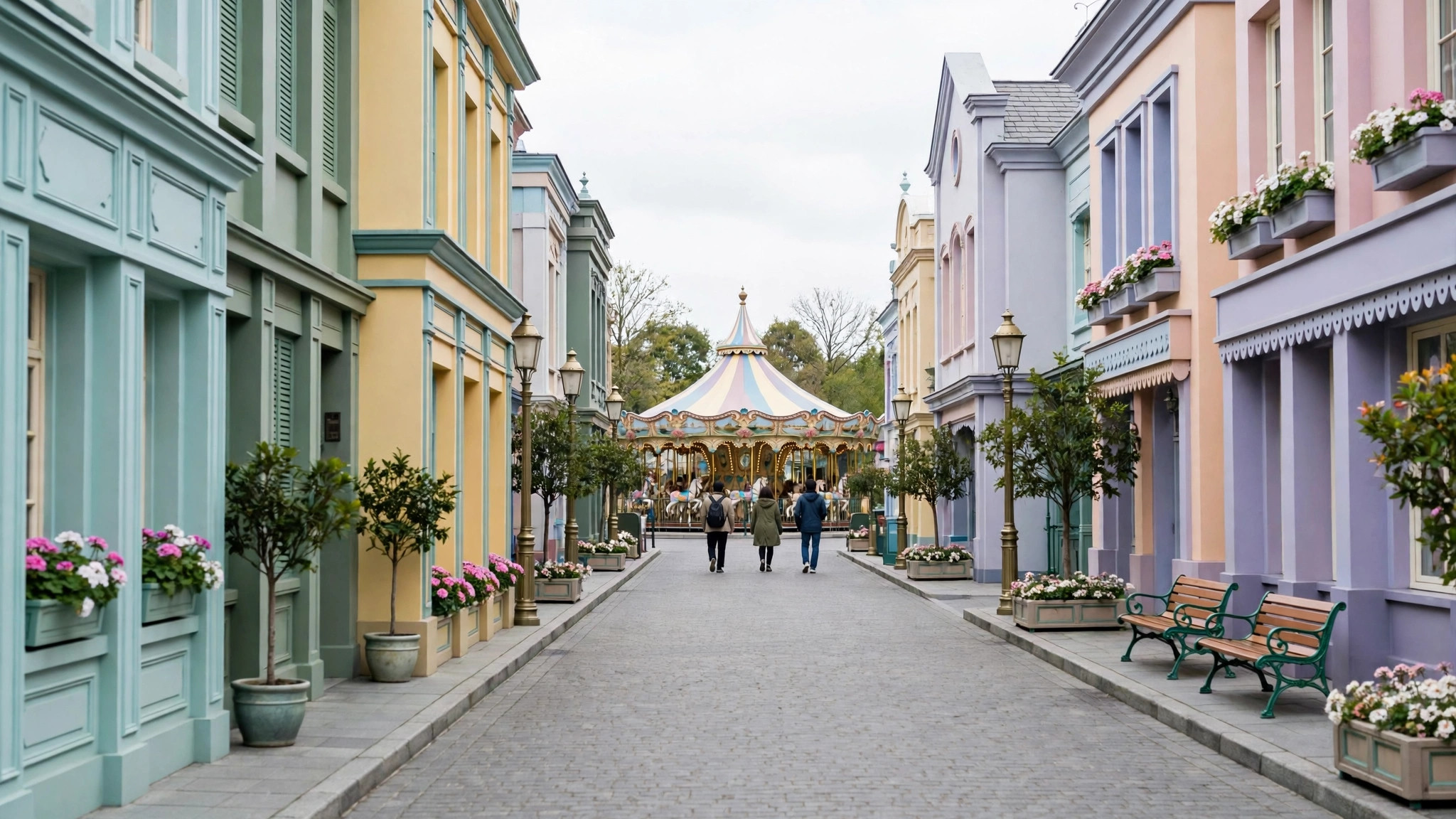
The bottom line
Theme park busiest days are written by the school calendar: holidays and Saturdays at the top, term-time midweek days at the bottom, with shoulder days around festivals as the hidden bargains. Inside the day, crowds build to a mid-afternoon peak, so the opening rush — gate early, far rides first, lunch off-peak, headliners again in the evening fade — is how a well-timed visitor turns the busiest attraction type into an easy, unhurried day.
