
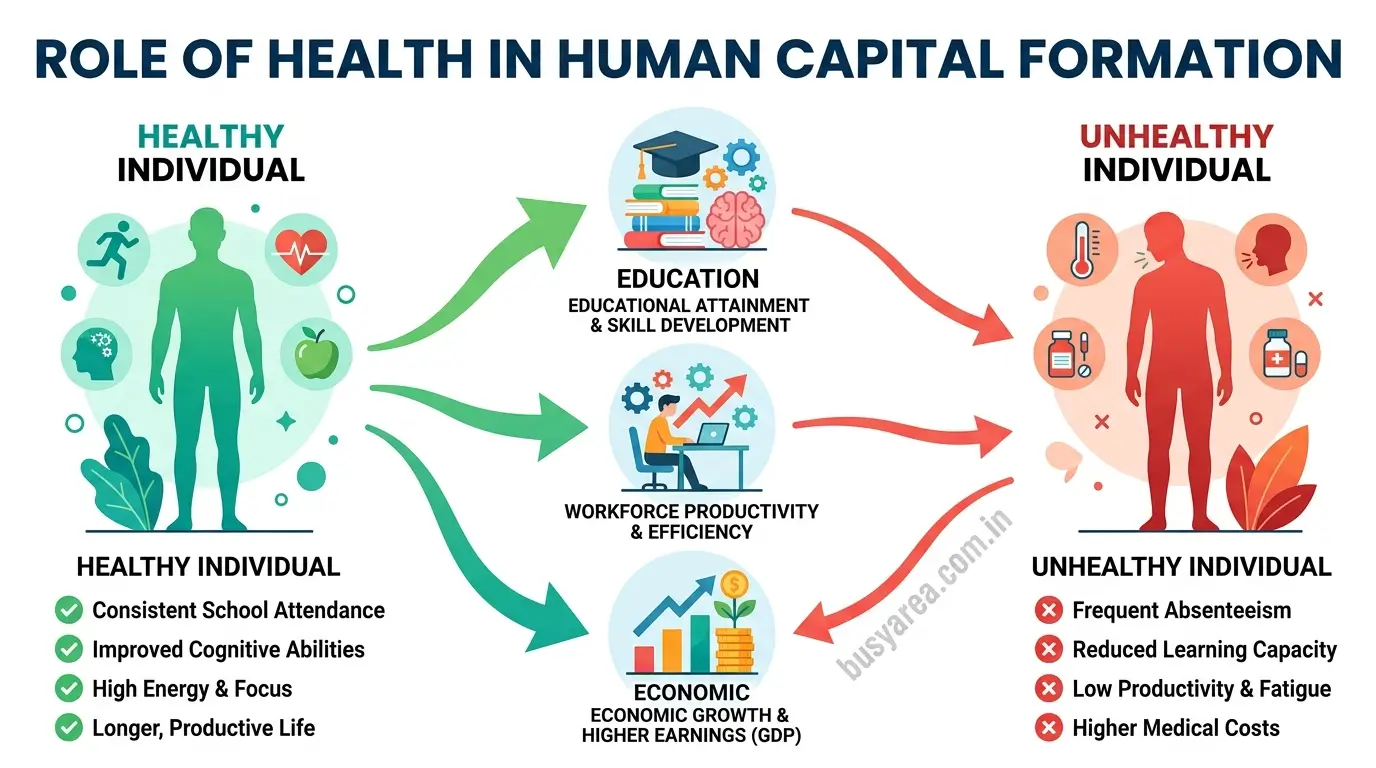
Human capital formation refers to the process of developing people’s skills, knowledge, and abilities so they can contribute effectively to economic growth and national development. Among its key drivers, health plays a foundational role because it directly determines how efficiently individuals can learn, work, and participate in productive activities. Without strong physical and mental well-being, even the best education systems and skill development programs fail to deliver their full potential.
The what is the role of health in human capital formation can be understood by examining how well-being influences productivity, learning capacity, and workforce efficiency. Good health improves human capital formation by ensuring that individuals remain active, focused, and capable of continuous skill development. It strengthens productivity by reducing illness-related absences and enhancing energy levels, while also supporting economic growth through a more capable and reliable workforce. In essence, health acts as the base upon which education, skills, and long-term economic progress are built.
What Is Human Capital Formation?
Human capital formation refers to the process of improving the knowledge, skills, health, and abilities of individuals so they can become more productive members of society. It is a long-term investment in people that helps increase their earning capacity and improves overall economic performance. Governments and institutions focus on it to strengthen the workforce and boost national development. The concept of what is the role of health in human capital formation is important here because human capital is not limited to education and skills only. It also includes human capital formation, which depends heavily on health status. A healthy population performs better in terms of productivity and contributes more effectively to economic growth, making health a foundational pillar of development.
Key Components of Human Capital
The key components of human capital include education, skills, and health, which together determine how productive and capable an individual can be in economic activities. These elements are essential because they shape a person’s ability to learn, work, and adapt to changing job requirements. Without strong human capital components, economic development becomes slow and less sustainable.
What is the role of health in human capital formation? These components are closely linked to human capital formation, which directly influences productivity and long-term economic growth. Education builds knowledge, skills improve practical efficiency, and health ensures that individuals have the physical and mental strength needed to apply their abilities effectively in real-world situations.
- Education: Builds knowledge, improves thinking ability, and increases job opportunities. It helps individuals become more productive and informed.
- Skills development: Provides practical training for specific jobs, improving efficiency and workplace performance. It bridges the gap between theory and practice.
- Health and nutrition: Ensures physical and mental well-being, increases energy levels, and reduces illness. It directly improves productivity and learning capacity.
Understanding the Role of Health in Human Capital
The role of health in human capital is a crucial aspect of economic development because it directly influences how effectively individuals can work, learn, and contribute to national productivity. A healthy population is more capable of participating in economic activities, which strengthens overall human capital formation. Good health improves both physical strength and mental stability, making it easier for individuals to perform tasks efficiently and consistently in the workforce. The what is the role of health in human capital formation becomes clear when we analyze how health affects productivity, workforce participation, and overall efficiency. Strong health conditions enhance productivity by reducing illness-related disruptions and improving energy levels.
Health as a Productivity Driver
Health acts as a powerful driver of productivity because it determines how efficiently individuals can perform their daily work activities. When people are healthy, they are more focused, energetic, and capable of completing tasks without unnecessary delays. This directly improves output at both the individual and organizational technology levels.
In human capital formation, good health strengthens workforce efficiency by ensuring consistent participation in economic activities. It also supports economic growth by creating a stable labor force that can sustain production and innovation over time.
- Reduced absenteeism: Healthy individuals take fewer sick leaves, which ensures continuous productivity and reduces disruptions in work schedules.
- Higher energy levels: Good health increases stamina and physical strength, allowing workers to perform tasks more efficiently throughout the day.
- Improved cognitive performance: Mental well-being enhances concentration, decision-making, and problem-solving abilities, leading to better work outcomes.
Read also: What is the role of health in human capital formation
How Health Improves Labor Productivity
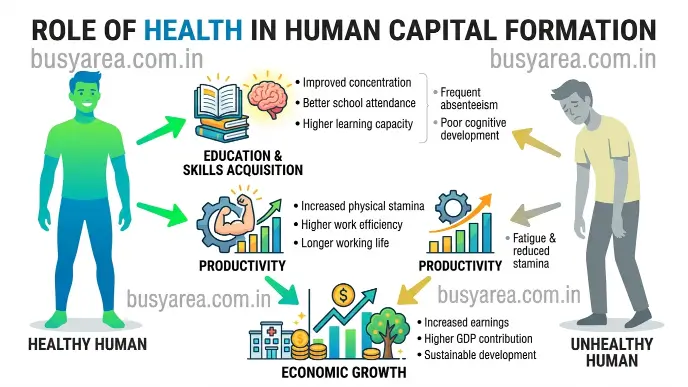
Health plays a fundamental role in improving labor productivity because it directly affects the physical and mental capacity of workers to perform their jobs efficiently. When individuals are healthy, they can work with greater consistency, focus, and energy, which leads to higher output in both industrial and service sectors. The what is the role of health in human capital formation becomes especially clear in the context of productivity because a healthy workforce reduces disruptions and enhances efficiency. Good health improves productivity by ensuring workers remain active and capable, while also supporting economic growth through increased production levels and reduced operational losses for businesses.
Role of Nutrition and Preventive Care
Nutrition and preventive care are essential components of labor productivity because they ensure that individuals maintain the physical strength and mental clarity needed for consistent performance. A balanced diet provides the energy required for daily work activities, while preventive healthcare reduces the risk of illness that can interrupt productivity. Together, they create a stable and efficient workforce.
In human capital formation, proper nutrition and preventive care strengthen workforce efficiency by reducing health-related absences and improving long-term working capacity. They also support economic growth by lowering healthcare costs for employers and increasing the overall productivity of the labor force.
Economic Growth and National Development
Economic growth and national development are strongly influenced by the health status of a country’s population. A healthy workforce increases productivity, reduces economic burdens, and enhances overall efficiency in production and services. When people are physically and mentally fit, they contribute more effectively to national income and development. Strong health systems support sustainable growth, improve living standards, and strengthen human capital formation by ensuring long-term economic stability and prosperity for society.
Economic Growth
- A healthy workforce increases productivity and boosts national income through efficient production and service delivery systems.
- Reduced disease burden lowers healthcare costs for governments and employers, improving economic resource allocation.
- Improved life expectancy strengthens long-term human capital formation and workforce availability.
- Better nutrition enhances cognitive abilities and physical strength, increasing labor efficiency across sectors.
- Strong healthcare systems support economic growth by maintaining a stable and productive population.
- Healthy citizens participate more in education, improving skill development and future productivity levels.
- Reduced absenteeism increases workplace consistency, leading to higher industrial and service output rates.
- Preventive healthcare reduces long-term treatment costs and improves economic sustainability for families and governments.
- Healthy populations attract foreign investment due to reliable and efficient workforce availability.
- Overall well-being strengthens national development by improving productivity, income distribution, and economic stability.
Health and Education: A Strong Connection
Health and education are deeply interconnected in shaping a nation’s human capital and long-term economic progress. A student’s ability to learn effectively depends not only on access to education but also on their physical and mental well-being. When children are healthy, they can attend school regularly, concentrate better in class, and absorb knowledge more efficiently. This strong connection plays a vital role in human capital formation and overall development. The what is the role of health in human capital formation becomes evident when we understand that poor health directly limits educational achievement and future productivity.
Impact of Childhood Health on Skill Formation
Childhood health has a long-lasting impact on skill formation because early physical and mental development determines how well a child can learn and acquire future abilities. Proper nutrition and healthcare during early years improve brain development, memory retention, and concentration levels. Healthy children are more likely to perform well academically and develop strong foundational skills.
In human capital formation, childhood health significantly enhances workforce efficiency by building a strong base for lifelong learning and skill development. It also supports economic growth by producing healthier, more educated, and more capable individuals who can contribute effectively to society in adulthood.
- Early nutrition: Supports brain development and improves cognitive abilities needed for learning and problem-solving.
- Better school performance: Healthy children attend school regularly and achieve higher academic results with better focus.
Government Role in Improving Health for Human Capital
The government plays a central role in improving population health, which is a key foundation of economic development and human capital formation. Through public policies, healthcare systems, and financial support programs, governments ensure that citizens have access to essential medical services. A strong healthcare system helps individuals remain healthy, productive, and capable of contributing to national development over the long term. The what is the role of health in human capital formation becomes especially clear here because government action directly strengthens human capital formation by improving productivity and supporting long-term economic growth.
Importance of Universal Healthcare Access
Universal healthcare access is essential because it ensures that every individual, regardless of income or social status, can receive basic medical services. This reduces health disparities across society and strengthens overall workforce capacity. When healthcare is accessible to all, more people remain healthy and able to participate in education and employment.
In human capital formation, universal healthcare improves workforce efficiency by ensuring that diseases are treated early and productivity losses are minimized. It also supports economic growth by increasing labor participation rates and reducing inequality in access to healthcare services.
- Reducing inequality: Universal healthcare ensures equal access to medical services, helping bridge the gap between rich and poor populations.
- Improving labor participation: Healthy individuals are more likely to join and remain active in the workforce, increasing national productivity levels.
Solutions to Strengthen Health in Human Capital Formation
Strengthening health systems is essential for improving human capital formation and ensuring long-term economic development. Governments, private institutions, and communities must work together to enhance healthcare access, improve nutrition, and promote preventive care. Effective solutions reduce disease burden, increase productivity, and support a healthier workforce. These measures directly improve human capital formation by boosting efficiency, learning capacity, and overall economic growth through better health outcomes and sustainable development strategies across all sectors.
Solutions to Strengthen Health
- Increase investment in healthcare infrastructure to improve hospitals, clinics, and medical service accessibility nationwide.
- Expand vaccination programs to prevent infectious diseases and reduce long-term health risks in populations effectively.
- Promote nutrition awareness campaigns encouraging balanced diets for better physical and mental development outcomes.
- Implement school health programs to support early detection of diseases and improve student learning performance.
- Provide affordable health insurance to reduce financial burden and improve access to medical treatments for all citizens.
- Strengthen rural healthcare systems to ensure equal access to medical services in remote and underserved areas.
- Encourage preventive healthcare practices like regular check-ups for early diagnosis and effective disease management.
- Improve sanitation and clean water supply to reduce the spread of diseases and enhance public health standards.
- Train healthcare professionals to ensure quality treatment and efficient patient care across healthcare facilities nationwide.
- Launch public awareness programs to educate citizens about hygiene, health, and disease prevention strategies effectively.
Frequently Asked Questions
What is the role of health in human capital formation?
Health plays a key role in human capital formation by improving productivity, learning ability, and workforce efficiency. A healthy population can work better, learn faster, and contribute more effectively to economic development.
How does health affect productivity in human capital?
Health directly affects productivity by reducing illness, increasing energy levels, and improving concentration. Healthy workers perform tasks more efficiently and take fewer sick leaves, leading to higher output.
Why is health important for economic growth?
Health is important for economic growth because a healthy workforce produces more goods and services, increases national income, and reduces healthcare-related economic burdens on governments and families.
What is the link between health and education?
Health and education are closely connected because healthy students attend school regularly, concentrate better, and achieve higher academic performance, which strengthens future human capital.
How can governments improve health for human capital formation?
Governments can improve health by investing in healthcare systems, promoting preventive care, offering subsidies, and ensuring universal access to medical services for all citizens.
Conclusion
Health is a fundamental pillar of human capital formation and plays a decisive role in shaping a nation’s economic future. A healthy population is more productive, better educated, and more capable of contributing to long-term development. Without good health, the benefits of education and skills development cannot be fully realized, which limits overall economic progress.
The what is the role of health in human capital formation can be clearly understood as a direct link between well-being and productivity, where improved health strengthens human capital formation and supports sustainable economic growth. Therefore, investing in healthcare is not only a social responsibility but also a powerful strategy for building a stronger and more prosperous economy.
